


 21:38
21:38
 Unknown

The 2012 Yamaha WR450F is here. But before we get into everything new, updated, borrowed and unique, you might want to ask yourself what your perfect 450cc-class off-road bike would be. Don’t compromise. Set your expectations high. After all, this is 2012.
We’d like to think a manufacturer could build a perfect bike for you, and never mind the fact that they have DOT, EPA, CARB and a slew of other acronyms to appease. We want two-stroke lightness, four-stroke traction, fuel-injected smoothness, plush suspension that never bottoms out, and we want it to look universally awesome and at the same time unique. We want it street legal and I want to race it, too. And make it cheap.
Knowing our consumer-bred difficulty going into this exercise is why it’s so exciting to test the latest offerings from the off-road motorcycle manufacturers. Just how close can they get? Well, Yamaha’s 2012 WR450 is the end result of a whole bunch of listening, tuning, tweaking, theorizing, manipulating, fixing and breaking stuff all in the name of finding the closest thing to perfection.

Hop on as we travel to central Florida and the opening round of the GNCC Racing series for a serious test of the 2012 fuel-injected Yamaha WR450F.
All New
Yamaha is showing some solid dedication to off-road with the release of this bike. In fact, the 2012 WR450F release breaks a stalemate of Japanese innovation, improvement and excitement in the off-road segment. The last new model - and the only fuel-injected version – we’ve seen from Japan was the Suzuki RMX450Z which debuted in 2010 as a motocrosser in disguise and is now off the American market altogether. Honda’s CRF450X is a workhorse for the big red brand, but it hasn’t changed much more than with minor tweaks here and there. Kawasaki’s KLX450R came quietly into the market in 2008, and we’ve had nary a bold new graphic from Team Green since. Yamaha itself hasn’t truly released a new WR since 2007! This bike is overdue, and the Yamaha faithful can finally be stoked.
While Yamaha has taken its sweet time bringing the new WR450F to market, it seems it’s done so with direct intention. The WR family has been a beacon of dependability, durability, customer satisfaction and ease-of-use for a long time. In the most-previous rendition, the WR450 specifically enjoyed a more-than-capable aluminum frame that kept the bike feeling new for years. The motor is a workhorse, producing ample ponies through great carburetor performance and a solid ride across the board with plush suspension tunable for almost any use. Stability is king with the WR, and straight-line performance has never been a question. Neither has dependability with the traditional five-titanium-valve cylinder head giving hundreds of hours of flawless performance to most. Add in a highly-functional enduro computer, decent stock headlight, comfortable ergos for a range of pilot sizes, and you start to see why Yamaha didn’t mess with the bike so long.
However, the old WR has its limits if used for more than just a dependable trail bike. It’s heavy by racing standards and doesn’t exude total confidence in the tightest of trails with the highest potential for tip-overs because of its sheer mass. It is low-slung and prone to finding the edge of ruts sooner than others, and it had a case of the wallows if ridden past stock suspension valving limits or speed.
Consumer Demand by the Numbers
Yamaha has been listening to its customers (and WR owners in particular) for quite some time. They’ve seen what people are buying and they know how they’re using these machines.
Current WR owners use their Yamaha WR for tight trails/woods riding nearly half the time they start them up. The next closest terrain is a virtual tie between fire roads and open desert riding. The vast majority of use by frequency is seen in the tight stuff. Surprised?
Another surprise to some may be the fact that a lot of WR owners race their machines. Recreationally focused off the dealer floor or not, Yamaha buyers are picking up WR250 and WR450 bikes and paying to race. As you might have guessed from the above paragraph, they’re racing mostly Enduros, Cross Country races and Hare Scrambles.
Sure, you’ve seen Randy Hawkins and the AmPro Yamaha team tear it up on highly modified WR’s for a few years. Despite what the fastest racers do, Yamaha studies show that everyday WR owners race their machines and they’re mostly self-proclaimed intermediates. These aren’t first-timers. They aren’t paid to race. They’re people like most of us who want a do-it-all machine that does it all perfectly.
With this data in hand, Yamaha went to the owners who are riding tight trails and racing on the weekends and asked them what they could do to improve their favorite bike. The answers are obvious. Make it lighter. Make it feel lighter. Improve the suspension. Give it fuel injection. Give it more fuel range. Make it look more awesome (I added that one, but I’m sure someone said that in the surveys). In the end, they came up with this concept: combine 450F power with a 250F chassis to make a precise and potent off-road weapon, focused squarely on cross-country and enduro racing.
While not as bold as KTM’s “Ready to Race” tagline, the focus from Yamaha on the competitive underbelly of off-road motorcycling is pretty aggressive. Yamaha executives further promised a more nimble ride, an easier-to-handle ride at a faster pace (more tuned to higher level racers), and the highest spec components available.
Engine Injection and More
To get to this new race-focused WR, Yamaha isn’t fixing what isn’t broken. The 449cc DOHC, Titanium five-valve, dry sump Yamaha powerplant still does the business of propulsion. Connected to a brand new fuel-Injection system and a wide-ratio 5-speed, the power and drivetrain on the WR remains proven, reliable and plenty powerful. However, they are refining things amongst its innards.
The engine orientation inside the chassis (we’ll get to the chassis soon) is kicked back to give the cylinder a more vertical stance. This picks the crank center up 5mm and puts the rotational mass of the dual cams closer to the center of the chassis. Gyroscopic forces inside the top of four-stroke motors have a significant effect on handling character and weight feel. The more spinning stuff is closer to the center of the machine, the better especially when flicking the bike side to side trying to change direction by leaning or when leaning with the front-end off the ground (essentially raising the spinning pieces even higher).
 The beauty of EFI shines brightly in all throttle positions. Open it up and let the bike go.
Down low, the big-end bearing and connecting rod are increased 1mm in width to increase durability. Also, the cam surface heat treatment has been revised to boost lifespan of the top spinners. The biggest news with the WR450 engine is easily the new EFI. Yamaha uses a 42mm Keihin fuel-injection system in the bike with a 12-hole injector for consistent performance and the lustful EFI throttle response MX bikes have been experiencing for a few years. Altitude, temperature and humidity now have little effect on your WR’s performance. And with beaucoup tunability, Yamaha ensures there are plenty of customizing options for race day.
The injection system is standard by today’s off-road and MX options. It has a lean-angle sensor with a tip-over switch to kill the engine in case of a fall or inversion lasting more than a handful of seconds. Yamaha isn’t telling us how long (for some reason) but they say in race situations, the bike will shut off if you’re non-responsive and the throttle’s stuck, for instance. Also, the bike won’t turn off too soon for silly tip-overs or playful loop-outs your buddies capture on film. I tested this plenty in the Florida sand, and it didn’t shut off by itself.
Also sending signals to the fuel delivery system is an intake air pressure sensor, throttle position sensor, air temperature sensor and water temperature sensor. The ECU is not tunable in stock form, but Yamaha has a good solution to that (yes, later). There’s a new intake boot to go along with the EFI system, and the easy-access air filter door stays put for filter changes that don’t cause cuss words to spill out of your face.
 Check engine light (in case of a ECU error code) and the handy low-fuel light on the 2012 WR450F’s gauges.
The fuel itself is held in an all-new 2.0 gallon fuel tank with the YZ450F-spec fuel pump nestled inside. I typed 2.0 because I secretly wish it said 2.5 or something more substantial behind the point. But, 2.0 is all we get for now. Range was not estimated at the press launch but some journalists went over 30 miles at a decent clip in power-sucking sand without a problem. We’ll guess somewhere in the 50-mile range when trail riding. The bike has a light that tells you when you’ve got a half-gallon left. Along with the on-board battery (for starting the beast), a new stator pumps up electrical output to 160 watts compared to the previous 120W. All of this juice goes to the EFI (no extra light juice, sorry). However, the EFI system can be completely independent of the battery in case you want to eliminate that sucker for maximum weight savings for, you know, racing the heck out of your dirt bike. Personally, I go for the button every time, but it’s nice to know the battery doesn’t need to be alive to make the bike fire.
Yamaha says the new WR450F radiators add 5% more coolant capacity, but they look bigger than that. The coolant overflow catch tank is intact and works well. If you manage to overcook the system, there is an escape hose that will spew steam from below the frame cradles. When this happens take the bike for a spin up and down a road or a straight section and lay off the clutch, would ya?
The last of the 2012 Yamaha WR450F engine updates is a longer (15mm longer) head pipe that incorporates a resonating chamber. Yamaha techs blame the mid-range lack of excitement they say is natural with EFI as the need for this change aimed at mid-range torque maintenance.
Sassy Chassis
While the previous generation WR was very capable at a wide range of racing and riding conditions, it had its limits in speed and agility. Yamaha addressed this directly with one of the most well-behaved modern motorcycle frames in the market—the YZ250F frame. Stable at speed, confident in the corners and solid, the bilateral-beam aluminum frame seems to blend the best of both worlds old and new. It feels narrower than full twin-spar jobs and doesn’t feel as non-existent or unsubstantial as the older Japanese steel frames used to be. While Yamaha engineers say the WR450F frame is “based-off” the YZ250F frame, we poked around and found out it really is more identical except for the engine mounts. Engine mounts can do a lot; don’t be fooled—look at some photos of James Stewart’s race bike sometime.
This new frame for the WR is said to be a more torsionally and horizontally rigid ride, but the head tube actually flexes a little more than the old frame. The new frame promises to eliminate wallowing and make rider input move the machine more efficiently. This little trick really masks some of the girth of the off-road big-boy. If it’s easier to move and doesn’t move against you, the bike will feel lighter and that’s what’s really important to saving energy while riding. When picking the bike up after going over the bars the new frame will not help. Yamaha engineers and test riders said the new frame/chassis setup was the most exciting part of the bike and something we’d feel immediately on the dirt.
One area of framemanship that differs entirely from the YZ250F is the sub-frame. Built specifically for the WR, this unit is responsible for holding unique stuff like batteries, electrical goodies and coolant catch tanks. It also is designed to be shorter at the back of the seat by 11mm over the previous WR version (easier to lift a leg over and lower overall seat height. The new WR is nearly an inch lower at the saddle (38.6” for 2011, 37.8” for 2012) while increasing ground clearance by 7mm. Swinging a leg over and moving back-and-forth is easier.
YZ Suspension Rules
 The Speed Sensitive fork from Yamaha is excellent.
Yamaha has been blessed with excellent suspension for a while now. The front ends of Yamaha’s have been butter smooth and plenty stout since incorporating the KYB Speed Sensitive fork. The air/oil separate speed sensitive system puts linear goodness to good use, and Kashima low-friction coatings slide nice. For the WR, this one addition is a monumental upgrade. The new fork drops the spring to the bottom, lowering mass, and the sheer upgrade in technology puts a realistically revalved fork on every new WR for 2012. The rear shock is dialed in and doesn’t disappoint. But the big story is in the YZ-spec fork.On top of everything else, the 2012 Yamaha WR450F has clearly gotten a facelift. The plastics all around are YZ250F-spec and put a narrower, nimble feeling at the knees and a nice, cool glare towards onlookers. It has a pretty bold headlight that is certainly scowling if not piercing. Night tests will show its effectiveness, but we expect it to be in line with the rest of Yamaha’s stock setups.
Complete the Package Price
The WR is truly new for 2012 and has a reasonable MSRP of $8,090. Adding consumer-demanded components like fuel injection, more nimble handling, a lighter feel, better suspension and an updated look to a historic performer in the off-road world should prove attractive to new and old Yamaha WR buyers alike—even those that might have considered going orange. If you’re looking at bottom-line numbers and performance, Yamaha is an attractive choice. And if you’re interested in racing, Yamaha has been paying special attention to you.
 Quick-adjust clutch perch is a premium-spec component.
Yamaha is giving new WR owners a ton of attention with in-house engineered and designed parts from the GYTR (Genuine Yamaha Technology Racing) sub-brand. The first purchase a WR buyer (racing or not) should make isn’t fuel for the tank, it’s the $99.95 GYTR Competition Kit and ECU that allows the WR to become the machine it can be. In stock form, it comes with the same 1/8th throttle stop screw that has plagued unsuspecting WR owners for years. The GYTR kit includes a justified screw replacement in the throttle body to allow 100% opening. In conjunction, remove the smallest (only the smallest) insert in the muffler and you’re ready for action.More, the Competition Kit comes with a pre-programmed ECU that drops in quickly under the left number plate. While being mapped for the full throttle opening, this ECU upgrade comes with integration capabilities to Yamaha’s slick GYTR Power Tuner (sold separately for ($279.95). Even without the tuner—find a friend with a YZ that bought one first!—this is a must-buy for WR owners simply for the throttle screw and the potential to tune. Don’t want more power? Perfect! There is no better or easier way in off-road to precisely dial in more or less power, traction, fuel consumption, timing, delivery, hit, snap, punch, torque, or anything else you could ever want to do with a power delivery curve. And it’s easy. If you can find a song on your iPod or find a phone number in your cell phone you can adjust power on your WR with the tuner.
On top of this must-buy, GYTR offers over 100 performance parts for the 2012 WR450F. From grip donuts to $2,200 CNC Ported cylinder heads with hi-perf cams included. A big seller is sure to be the GYTR by FMF Slip-on Muffler for $299.95.
As an example of value, check this out: For our two days of testing in the Florida swampland, we ran the bike in two configurations. One had the stock ECU with the throttle screw and muffler insert fix done – essentially as stock as you can get while still being fully capable. The next day we ran a nice race setup with this list of GYTR add-ons: Competition Kit, GYTR by FMF muffler, radiator braces, flag-style hand guards, and a sleek rear disc guard. The total cost for all these parts is $544 out tha’ door. Added to the MSRP of $8,090 that’s over $500 CHEAPER than a stock KTM 450 XC-W (based on a $9,200 MSRP).
Florida Torture
The opening round of the GNCC series in Florida is notoriously brutal. Yamaha is confident enough in their new WR450F to take it right to the fight there. Soul-sucking sand reaches up at every moment trying to pull the last carbohydrate and water droplet out of your system. It’s no cakewalk for bikes either. Imagine two-foot-deep sand whoops for 13 miles mixed with a nice blend of clutch killing pine trees and simply horrific Palmetto fields. A Palmetto is a small palm tree that grows along the ground before growing skyward. When raced through, you essentially deal with their stumps (laying on the ground and pointing vertically at random) which do their best to stop you in your tracks/murder you.
In stock tune, the biggest surprise (as predicted by Yamaha officials) was the much more capable chassis and suspension. Immediately, the WR wallow nearly vanished. The new bike is more nimble and reacts much faster to rider input. In case you make an unintelligent input, the bike helps you cover your mistakes a lot better as well. Nothing tests limits of stability and chassis flex more than repetitious-yet-random sand whoops. The big bikes usually bury themselves in the gaps and spring off the mounds unpredictably. Only when really ridden to the point of drastic mistakes did the WR rear a faint sign of behaving like a big, heavy four-stroke.
Equal credit here is due to the fork system and settings as it is the MX chassis rigidity and flex blend. No, there weren’t many landings, per se, but the slow-stroke full-suspension movement delivered by the ledges and sandy moguls provided a brutal test of compliance. Stutter bumps (Palmetto roots) were absorbed almost magically at speed. Plush enough to make a magic carpet ride and progressive ahead of the big move curve is a combination that usually comes from a custom revalve. Yamaha has given you the revalve if you’re less than 200 pounds. If you’re over that weight or pushing the pro-ranks, head to stiffer spring rates to keep it up in the stroke more, and I predict you’ll be extremely happy with the WR suspension and handling.
The 2012 motor feels just as responsive and powerful as ever, and the response is off the charts. Right off idle, the bike cracks off with a gallop of torque and acceleration that should be patented. Great roll-on power through the bottom end starts to accelerate into the mid quickly. You can run out of first and second gear sooner than you think, but third is nice and long and the WR has the power and consistency to pull the third cog in a wide range of terrain. Shifting is smooth, so use your left foot if necessary to drop to second. The bike isn’t stall-proof, and firing it up isn’t always immediate (the motor can churn without igniting). I’m hoping with some power tuning, the electric starting performance is improved.
The bottom-to-mid power really enhances this lighter weight feel of the WR. More responsive bikes don’t wait for you to move them, they move themselves. Combined with chassis enhancements, the WR really does feel lighter than previous even though it’s technically a bit heavier on the scale. Top end power was good to push the WR into the upper 70-mph range with consistent, smooth yank.
Engine overheating wasn’t an issue, even with the less-than-ideal Florida conditions. Photo runs are essentially motionless with the bike running until it’s time to hit a spot, usually requiring plenty of clutch. The bike did bubble back to the catch tank a few times, but with a decent breeze blowing across the radiators it seemed cool-headed enough. Everything else in our first day of testing went smoothly.
To really put the new WR to the test, we were entered in the two-hour morning event at the GNCC before it gets inhumanly nasty out there with the pros. Yamaha took the opportunity to set us up with a GYTR-kitted bike.
And the mods really work. First off, the Competition ECU and GYTR by FMF muffler don’t ruin the power. You might laugh at that but I’ve seen exhaust systems and pumped up ignitions totally destroy usability and powerband width. The GYTR mods don’t turn it into a tire-spinning useless snap-monster. They put more power to the ground across the board. Testing personnel from Yamaha described it as a more torquey delivery from top to bottom without more snap. They were right. I think there might be a bit more snap but not an obnoxious or bad amount (unless you’re really tired).
We ran the spark-arrestor screen in the muffler, and the sound output was beautiful—a good hot-rod note with a cleanliness to it that is perfect for racing. Too loud for me to trail ride all the time (and the power from the stock muffler is really nice for off-road recreational riding), but for closed-course racing, this combo is dynamite.
The rest of the GYTR catalog we threw at the WR worked without interference—as designed. I didn’t test the radiator braces, but I tried (sand is soft). The Cycra flag guards kept the Florida foliage from smashing my knuckles.
Race situations provide unique, real-world feedback you can’t find on a casual trail ride or a photo shoot. From out-braking a competitor to a corner to wheel-hopping a whoop rhythm section to bust past a ledge, the 13-mile lap of a GNCC course brings everything from rutted swampland to high-speed grass track. The WR made all conditions seem like it was born to perform there. It was very impressive throughout.
In the heat of battle millimeters of movement make a big difference. The chassis upgrades give you more energy towards the end of a race, and suspension performance can keep you out of harm’s way as your mental integrity breaks down with exhaustion. The YZ-inspired bodywork and tank combine with the lower/flatter seat to make the WR effortless to move around on. From standing through the whoops to sliding forward in beautiful sand berms, the bike has moto-mobility to the max.
During the heat of battle a few things came up that I wish the WR did better. First on the list is the aforementioned starting. Kick-starting was consistent as heck during my practice starts (GNCC racing is dead engine starting), but on most e-start bikes, I can combine a kick with a button and ignite it every time. This combo didn’t work at all on the WR. And it’s much faster (usually) to kick than to push the button in a race-start situation. Of course, when the flag dropped, the bike didn’t fire and I kicked it a couple times before heading onto the course. Typical for me, really.
 Third, I think the WR brake performance needs to step up to beat the leaders in the class. I didn’t have a ton of issues, but I didn’t like how I had to pump the front a couple times to get good lever feel – I’d rather have more power in the binders than I need. For a race-ready ride, I want big-time brakes.
Lastly, I think most off-road riders would appreciate a few more positive decimals behind the 2.0 in fuel capacity. Off-road tests will determine what the actual range is.
Conclusion
In the off-road motorcycle world, there has been a monopoly taking place for the past few years. It’s no secret KTM has introduced troves of new models to display the company’s dominance in the marketplace of niches. It’s really hard to compete with that as a brand if you’re only making two off-road-specific models.
Head-to-head, Yamaha thinks it’s got something that can stand up to the XC-W. While no one came out and said they’re gunning for orange, the value of the WR and the first race test I experienced puts it in the ballpark, at least. With an MSRP of just $8,090 plus the GYTR kit, it’s $1100 less than KTM’s 450 XC-W.
No matter how the WR stacks up in the months to come, Yamaha has clearly succeeded in providing a drastic improvement in a stagnant model. And they did it with you in mind. So ask yourself again what you want your off-road 450 to do for you. I can’t quite find something this WR couldn’t handle with ease.
We’d like to think a manufacturer could build a perfect bike for you, and never mind the fact that they have DOT, EPA, CARB and a slew of other acronyms to appease. We want two-stroke lightness, four-stroke traction, fuel-injected smoothness, plush suspension that never bottoms out, and we want it to look universally awesome and at the same time unique. We want it street legal and I want to race it, too. And make it cheap.
Knowing our consumer-bred difficulty going into this exercise is why it’s so exciting to test the latest offerings from the off-road motorcycle manufacturers. Just how close can they get? Well, Yamaha’s 2012 WR450 is the end result of a whole bunch of listening, tuning, tweaking, theorizing, manipulating, fixing and breaking stuff all in the name of finding the closest thing to perfection.
All New
Yamaha is showing some solid dedication to off-road with the release of this bike. In fact, the 2012 WR450F release breaks a stalemate of Japanese innovation, improvement and excitement in the off-road segment. The last new model - and the only fuel-injected version – we’ve seen from Japan was the Suzuki RMX450Z which debuted in 2010 as a motocrosser in disguise and is now off the American market altogether. Honda’s CRF450X is a workhorse for the big red brand, but it hasn’t changed much more than with minor tweaks here and there. Kawasaki’s KLX450R came quietly into the market in 2008, and we’ve had nary a bold new graphic from Team Green since. Yamaha itself hasn’t truly released a new WR since 2007! This bike is overdue, and the Yamaha faithful can finally be stoked.
 In stock trim, the WR has solid cred with an aggressive look. Its performance matched the stance. In stock trim, the WR has solid cred with an aggressive look. Its performance matched the stance. |
However, the old WR has its limits if used for more than just a dependable trail bike. It’s heavy by racing standards and doesn’t exude total confidence in the tightest of trails with the highest potential for tip-overs because of its sheer mass. It is low-slung and prone to finding the edge of ruts sooner than others, and it had a case of the wallows if ridden past stock suspension valving limits or speed.
Consumer Demand by the Numbers
Yamaha has been listening to its customers (and WR owners in particular) for quite some time. They’ve seen what people are buying and they know how they’re using these machines.
Current WR owners use their Yamaha WR for tight trails/woods riding nearly half the time they start them up. The next closest terrain is a virtual tie between fire roads and open desert riding. The vast majority of use by frequency is seen in the tight stuff. Surprised?
Another surprise to some may be the fact that a lot of WR owners race their machines. Recreationally focused off the dealer floor or not, Yamaha buyers are picking up WR250 and WR450 bikes and paying to race. As you might have guessed from the above paragraph, they’re racing mostly Enduros, Cross Country races and Hare Scrambles.
 The River Ranch GNCC provided an abundance of terrain. From wide-open to balancing acts, it was a great testing ground for Yamaha’s newest off-roader. The River Ranch GNCC provided an abundance of terrain. From wide-open to balancing acts, it was a great testing ground for Yamaha’s newest off-roader. |
With this data in hand, Yamaha went to the owners who are riding tight trails and racing on the weekends and asked them what they could do to improve their favorite bike. The answers are obvious. Make it lighter. Make it feel lighter. Improve the suspension. Give it fuel injection. Give it more fuel range. Make it look more awesome (I added that one, but I’m sure someone said that in the surveys). In the end, they came up with this concept: combine 450F power with a 250F chassis to make a precise and potent off-road weapon, focused squarely on cross-country and enduro racing.
While not as bold as KTM’s “Ready to Race” tagline, the focus from Yamaha on the competitive underbelly of off-road motorcycling is pretty aggressive. Yamaha executives further promised a more nimble ride, an easier-to-handle ride at a faster pace (more tuned to higher level racers), and the highest spec components available.
Engine Injection and More
To get to this new race-focused WR, Yamaha isn’t fixing what isn’t broken. The 449cc DOHC, Titanium five-valve, dry sump Yamaha powerplant still does the business of propulsion. Connected to a brand new fuel-Injection system and a wide-ratio 5-speed, the power and drivetrain on the WR remains proven, reliable and plenty powerful. However, they are refining things amongst its innards.
 A flickable WR? Yes! A flickable WR? Yes! |
The beauty of EFI shines brightly in all throttle positions. Open it up and let the bike go.The injection system is standard by today’s off-road and MX options. It has a lean-angle sensor with a tip-over switch to kill the engine in case of a fall or inversion lasting more than a handful of seconds. Yamaha isn’t telling us how long (for some reason) but they say in race situations, the bike will shut off if you’re non-responsive and the throttle’s stuck, for instance. Also, the bike won’t turn off too soon for silly tip-overs or playful loop-outs your buddies capture on film. I tested this plenty in the Florida sand, and it didn’t shut off by itself.
 Quick access is an off-road must. Quick access is an off-road must. |
Check engine light (in case of a ECU error code) and the handy low-fuel light on the 2012 WR450F’s gauges.Yamaha says the new WR450F radiators add 5% more coolant capacity, but they look bigger than that. The coolant overflow catch tank is intact and works well. If you manage to overcook the system, there is an escape hose that will spew steam from below the frame cradles. When this happens take the bike for a spin up and down a road or a straight section and lay off the clutch, would ya?
The last of the 2012 Yamaha WR450F engine updates is a longer (15mm longer) head pipe that incorporates a resonating chamber. Yamaha techs blame the mid-range lack of excitement they say is natural with EFI as the need for this change aimed at mid-range torque maintenance.
Sassy Chassis
While the previous generation WR was very capable at a wide range of racing and riding conditions, it had its limits in speed and agility. Yamaha addressed this directly with one of the most well-behaved modern motorcycle frames in the market—the YZ250F frame. Stable at speed, confident in the corners and solid, the bilateral-beam aluminum frame seems to blend the best of both worlds old and new. It feels narrower than full twin-spar jobs and doesn’t feel as non-existent or unsubstantial as the older Japanese steel frames used to be. While Yamaha engineers say the WR450F frame is “based-off” the YZ250F frame, we poked around and found out it really is more identical except for the engine mounts. Engine mounts can do a lot; don’t be fooled—look at some photos of James Stewart’s race bike sometime.
This new frame for the WR is said to be a more torsionally and horizontally rigid ride, but the head tube actually flexes a little more than the old frame. The new frame promises to eliminate wallowing and make rider input move the machine more efficiently. This little trick really masks some of the girth of the off-road big-boy. If it’s easier to move and doesn’t move against you, the bike will feel lighter and that’s what’s really important to saving energy while riding. When picking the bike up after going over the bars the new frame will not help. Yamaha engineers and test riders said the new frame/chassis setup was the most exciting part of the bike and something we’d feel immediately on the dirt.
 Throttle response makes lifting the front end easier than previous versions of Yamaha’s WR. With its lower seat height and less stink-bug feel, the WR is more usable in all technical trail situations. Throttle response makes lifting the front end easier than previous versions of Yamaha’s WR. With its lower seat height and less stink-bug feel, the WR is more usable in all technical trail situations. |
YZ Suspension Rules
The Speed Sensitive fork from Yamaha is excellent.Complete the Package Price
The WR is truly new for 2012 and has a reasonable MSRP of $8,090. Adding consumer-demanded components like fuel injection, more nimble handling, a lighter feel, better suspension and an updated look to a historic performer in the off-road world should prove attractive to new and old Yamaha WR buyers alike—even those that might have considered going orange. If you’re looking at bottom-line numbers and performance, Yamaha is an attractive choice. And if you’re interested in racing, Yamaha has been paying special attention to you.
Quick-adjust clutch perch is a premium-spec component.On top of this must-buy, GYTR offers over 100 performance parts for the 2012 WR450F. From grip donuts to $2,200 CNC Ported cylinder heads with hi-perf cams included. A big seller is sure to be the GYTR by FMF Slip-on Muffler for $299.95.
 This GYTR by FMF muffler puts more torque and power everywhere in the power curve. This GYTR by FMF muffler puts more torque and power everywhere in the power curve. |
Florida Torture
The opening round of the GNCC series in Florida is notoriously brutal. Yamaha is confident enough in their new WR450F to take it right to the fight there. Soul-sucking sand reaches up at every moment trying to pull the last carbohydrate and water droplet out of your system. It’s no cakewalk for bikes either. Imagine two-foot-deep sand whoops for 13 miles mixed with a nice blend of clutch killing pine trees and simply horrific Palmetto fields. A Palmetto is a small palm tree that grows along the ground before growing skyward. When raced through, you essentially deal with their stumps (laying on the ground and pointing vertically at random) which do their best to stop you in your tracks/murder you.
 Trail-situation drop-offs and high-speed jumps are handled with confidence by the WR’s new frame and suspension. Trail-situation drop-offs and high-speed jumps are handled with confidence by the WR’s new frame and suspension. |
Equal credit here is due to the fork system and settings as it is the MX chassis rigidity and flex blend. No, there weren’t many landings, per se, but the slow-stroke full-suspension movement delivered by the ledges and sandy moguls provided a brutal test of compliance. Stutter bumps (Palmetto roots) were absorbed almost magically at speed. Plush enough to make a magic carpet ride and progressive ahead of the big move curve is a combination that usually comes from a custom revalve. Yamaha has given you the revalve if you’re less than 200 pounds. If you’re over that weight or pushing the pro-ranks, head to stiffer spring rates to keep it up in the stroke more, and I predict you’ll be extremely happy with the WR suspension and handling.
 This is the best handling WR ever. This is the best handling WR ever. |
The bottom-to-mid power really enhances this lighter weight feel of the WR. More responsive bikes don’t wait for you to move them, they move themselves. Combined with chassis enhancements, the WR really does feel lighter than previous even though it’s technically a bit heavier on the scale. Top end power was good to push the WR into the upper 70-mph range with consistent, smooth yank.
 Big radiators provided excellent cooling performance in our first runs. Big radiators provided excellent cooling performance in our first runs. |
 Another smart add-on is radiator braces. Unless you never crash. Another smart add-on is radiator braces. Unless you never crash. |
To really put the new WR to the test, we were entered in the two-hour morning event at the GNCC before it gets inhumanly nasty out there with the pros. Yamaha took the opportunity to set us up with a GYTR-kitted bike.
And the mods really work. First off, the Competition ECU and GYTR by FMF muffler don’t ruin the power. You might laugh at that but I’ve seen exhaust systems and pumped up ignitions totally destroy usability and powerband width. The GYTR mods don’t turn it into a tire-spinning useless snap-monster. They put more power to the ground across the board. Testing personnel from Yamaha described it as a more torquey delivery from top to bottom without more snap. They were right. I think there might be a bit more snap but not an obnoxious or bad amount (unless you’re really tired).
We ran the spark-arrestor screen in the muffler, and the sound output was beautiful—a good hot-rod note with a cleanliness to it that is perfect for racing. Too loud for me to trail ride all the time (and the power from the stock muffler is really nice for off-road recreational riding), but for closed-course racing, this combo is dynamite.
The rest of the GYTR catalog we threw at the WR worked without interference—as designed. I didn’t test the radiator braces, but I tried (sand is soft). The Cycra flag guards kept the Florida foliage from smashing my knuckles.
Race situations provide unique, real-world feedback you can’t find on a casual trail ride or a photo shoot. From out-braking a competitor to a corner to wheel-hopping a whoop rhythm section to bust past a ledge, the 13-mile lap of a GNCC course brings everything from rutted swampland to high-speed grass track. The WR made all conditions seem like it was born to perform there. It was very impressive throughout.
In the heat of battle millimeters of movement make a big difference. The chassis upgrades give you more energy towards the end of a race, and suspension performance can keep you out of harm’s way as your mental integrity breaks down with exhaustion. The YZ-inspired bodywork and tank combine with the lower/flatter seat to make the WR effortless to move around on. From standing through the whoops to sliding forward in beautiful sand berms, the bike has moto-mobility to the max.
During the heat of battle a few things came up that I wish the WR did better. First on the list is the aforementioned starting. Kick-starting was consistent as heck during my practice starts (GNCC racing is dead engine starting), but on most e-start bikes, I can combine a kick with a button and ignite it every time. This combo didn’t work at all on the WR. And it’s much faster (usually) to kick than to push the button in a race-start situation. Of course, when the flag dropped, the bike didn’t fire and I kicked it a couple times before heading onto the course. Typical for me, really.
Second, I think hand guards should be standard on off-road bikes. The WR is likely to be used more than half the time in tight trails and woods, yet it lacks standard hand protection. It has a fantastic, full-coverage, tough plastic plate that is absolutely perfect in my opinion, but nothing for my digits.
 Third, I think the WR brake performance needs to step up to beat the leaders in the class. I didn’t have a ton of issues, but I didn’t like how I had to pump the front a couple times to get good lever feel – I’d rather have more power in the binders than I need. For a race-ready ride, I want big-time brakes.
 Lastly, I think most off-road riders would appreciate a few more positive decimals behind the 2.0 in fuel capacity. Off-road tests will determine what the actual range is.
Conclusion
In the off-road motorcycle world, there has been a monopoly taking place for the past few years. It’s no secret KTM has introduced troves of new models to display the company’s dominance in the marketplace of niches. It’s really hard to compete with that as a brand if you’re only making two off-road-specific models.
Head-to-head, Yamaha thinks it’s got something that can stand up to the XC-W. While no one came out and said they’re gunning for orange, the value of the WR and the first race test I experienced puts it in the ballpark, at least. With an MSRP of just $8,090 plus the GYTR kit, it’s $1100 less than KTM’s 450 XC-W.
 |
 Posted in:

 It may be over-sprung, but the Zuma’s stiff suspension turns elevated manhole covers into impromptu ramps.
  It’s not the fastest 125cc scooter, but the Zuma confidently navigates inter-city traffic with peppy thrust and good brakes.
 A hacksaw will make quick work of the Zuma’s unnecessary second rear fender and clean up the rear of the scooter. For 2012 the Zuma 125 is also available in white.
 More responsive power is perhaps the most obvious improvement for 2012.
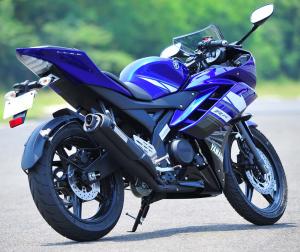
 Confident handling, improved power delivery as well as incredible stability make the Yamaha R15 V2.0 a significantly better motorcycle to ride on a racetrack.
 It’s hard to tell, but the throttle is wide open in this shot. If you look closely you can see a faint trail of rubber being left behind.
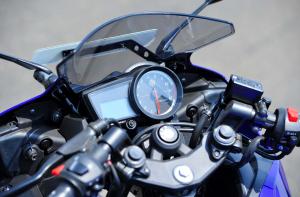
  The gauge cluster looks largely the same, except for the addition of a “TCS” light at the top right. The bar graph at the top right of the LCD panel indicates which level of traction control is currently set.
 Changes to the headlight cowl come in the form of larger LED position lamps at the outer edges and reflectors on the lower portion of the fairing. Minor changes, but they give the R1 a more aggressive look.
  In honor of Yamaha’s 50th year in Grand Prix racing the company has created a limited-edition (2000 units) commemorative red/white livery for the R1. The YZF-R6 will also get the commemorative treatment.
 Adjusting the traction control is a matter of toggling up or down on the “TCS” switch on the left handlebar.
  The D-Mode drive mode system returns on the 2012 R1 with the same three settings: A, B and Standard. Standard provides the optimum throttle application in most situations, as A mode feels too abrupt and B is rather lackluster.
  The new R1’s street manners haven’t changed much from the previous version. Heat emanating from the engine and undertail exhausts radiates directly to the rider, which is especially brutal on warm days.
 A warm day can cause tar slicks on roads like this to get slick. Combine that with worn tires and traction control could come in handy to prevent a crash.
 Once the R1 is on its side, stability is superb.
  At 454 pounds, the R1 is still one of the heavier literbikes on the market. But that doesn’t take away from its fun factor.
 A turn like this is perfect for using the throttle to steer the motorcycle, as it opens on exit. Lower TC settings still allow this to happen, while higher settings intervene more.

 The new Zuma 50F is a great tool for checking out San Francisco landmarks.
 The seating position on the new Zuma is much more neutral compared to the outgoing model, a feature that makes all-day riding very comfortable.
 With the fuel tank relocated to the floorboard area, a lot of room was freed up underneath the seat for storage. Enough, even, for a full-face helmet. Note also the passenger grab rail and luggage rack to the rear of the scooter.
 San Francisco’s notorious inclines weren’t enough to stop the little Zuma, but don’t expect to scale them in any hurry. More often than not you’ll have to concede to bigger, faster vehicles.
 Suspension, wheels and tires are holdovers from last year. Ride quality is actually quite comfortable considering the basic suspension. More impressive is the 185mm wave-type brake disc that brings the Zuma to a stop quickly.
 If your transportation needs include something that’s reliable, economical and practical, the Zuma 50F could be what you’re looking for.
 The revised R1 for 2012 gets a nose job, some plastic surgery in the rear, and most importantly, traction control.
 Yamaha’s beginner bike, the V Star 250 remains largely unchanged except for new drag-style bars that replace the wrap-around units on the outgoing model.
 Two models that were “delayed” for 2011, the Roadliner S (left) and Stratoliner S (right) return for 2012 with styling updates to help them appeal to a broader audience.
  Also getting a facelift is the new Stratoliner Deluxe. It also gets a host of new features to answer critics who wanted more from the Strato Deluxe.
 The standard Raider remains unchanged except for new colors like Nebulous Purple and Liquid Silver, seen here.
 The big news from Star is the introduction of the SCL, or Star Custom Line. Starting with the Raider SCL, buyers will have a chance to own a true factory custom without the exorbitant cost.


