Hiển thị các bài đăng có nhãn Ducati Reviews. Hiển thị tất cả bài đăng

Thứ Năm, 16 tháng 5, 2013

Ducati Multistrada 1200 S Touring 2013 Review

Ducati broke open a niche in the adventure-touring market when it introduced the 2010 Multistrada, adopting the rugged appeal of the class but without much of the implied dirtbike-ness of the segment-leading BMW R1200GS. Despite being plopped into the A-T category, the MTS became the Italian brand’s de facto sport-touring bike.
More than 20,000 Multistradas have been sold over just 30 months, which is a sizeable number for a company that sells only 40,000 bikes a year. And of the various MTS models, it’s the travel-oriented S Touring version that sells best.
And of critical importance to Ducati’s long-term solvency is that the MTS is the first Ducati for about 80% of its owners. It is greatly expanding the appeal of what Ducati means to consumers.


The above is important to understanding why the long-legged Duc has been given an overhaul after less than three years on the market. The list of items new or retooled is extensive: cylinder heads, windshield, fairing, suspension, wheels, traction control and ABS. Ducati says the goal of the 2013 model is to further develop the bike’s touring ability without compromising its four-motorcycles-in-one concept.
Two new features on the 2013 Multi fight for the spotlight: a revised engine and a semi-active suspension. Since the “Skyhook” suspension is available only on upmarket S-class Multis and the motor mods apply to all Multistradas, we’ll begin in the engine room.
Ducati did an amazing job converting its 1198cc superbike V-Twin into a much more streetable mill for use in the MTS and, later, the Diavel. Its key modification was reducing valve overlap from the hi-po superbike’s 41 degrees to just 11 degrees, hence its “Testastretta 11°” nomenclature. However, fueling at low revs was a mite lumpy, especially in Sport mode, so Ducati engineers made three key changes to create the new “Testastretta 11° DS.”  
2013 Ducati Multistrada 1200 S GranturismoSupplementing the Multistrada’s touring theme is the addition of a Granturismo version. It boasts 20mm-higher bars, a wider and taller windscreen, touring seats, crash bars and LED driving lights, plus larger saddlebags and a 48-liter top case with integral backrest. It will retail for $21,995 when it hits North American dealers in Q1 of 2013.
The “DS” indicates dual spark, which features a second spark plug placed to the side of the cylinder head for more complete combustion. Further to that end is a secondary air system that pipes fresh air from the airbox through a reed valve in the cylinder heads. This enables the ECU to deliver a richer mixture at low loads and revs while still meeting emissions regs, making reapplication of throttle less lurchy. In addition, the fuel injectors are now aimed to spritz petrol directly at the inlet valves instead of at the wall of the intake duct, and this greatly aids fuel atomization rather than forming hard-to-digest droplets.
The result of these tweaks is a 5% boost in peak torque to 91.8 ft-lb, and a Ducati-supplied dyno chart shows a slight bump in power across nearly the entirety of its pull. Ducati also claims a 10% increase in fuel economy at 55 mph.
More importantly, the DS now responds much cleaner at low revs, aiding rider confidence while expanding the usable range of its powerband. Horsepower remains at a claimed 150 crankshaft horsies (or about 132 hp at the wheel). Power delivery and output is varied via four riding modes (Sport, Touring, Urban and Enduro).
2013 Ducati Multistrada 1200 S Pikes PeakDon’t care about touring? Then order up this 1200 S Pike’s Peak tribute edition that eschews saddlebags and a centerstand for carbon-fiber components, pinstriped forged-aluminum wheels, bespoke paint and a red-stitched seat, plus a Termignoni exhaust canister. It shares the Granturismo’s $21,995 MSRP.
The base Multistrada retails for the same $16,995 it did in 2012, and it now includes the addition of LED low-beam headlights that combine with the existing LED position lights, both of which remain lit when the incandescent high beams are switched on for maximum visibility.
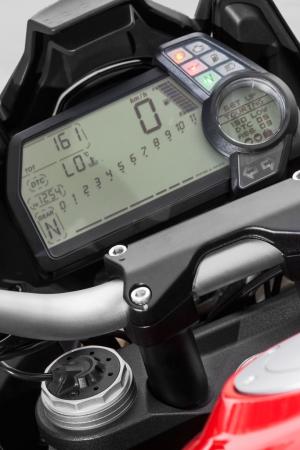
2013 Ducati Multistrada 1200 display
Also new is the front fairing and a higher and wider windscreen that now features a clever pinch-and-slide adjustment instead of the previous two-knob arrangement, enabling on-the-fly tuning over its identical 60mm vertical range. The storage bin on right side of the cockpit gets enlarged, and its new wheels are similar to the Panigale’s. A dual-rate shock spring replaces a single-rate spiral for greater bottoming resistance.
In addition, the now-standard Ducati Safety Pack gets updated. Ducati Traction Control remains tied to different riding modes and can also be set independently to eight levels. If tire slip is detected, intervention is purported to be smoother thanks to new software which can deliver as much as a 60% torque reduction with only ignition intervention before cutting fuel.The standard ABS system is now governed by the Bosch 9ME ECU as used in the Panigale, employing four pressure sensors (both master cylinders and front and rear calipers). The Brembo brakes are linked front to rear, with less linkage in the Sport and Enduro modes. Rear-lift detection is switched off in Sport and Enduro modes (stoppies, anyone…?). The rear tire can be skidded in Enduro, and ABS can be disabled in any mode. Any electronic setting can be manually altered and stored in memory simply by switching off the ignition.
Upgrading to the S Touring version ($19,995) gets several important additions, including removable and lockable saddlebags, a centerstand and heated grips. But most interesting is the Skyhook semi-active suspension that replaces ordinary but fully adjustable suspenders on the base version.
Ducati Skyhook Suspension (DSS) is a high-tech suspension system similar to BMW’s new HP4 using Sachs electronic solenoid valves in the left fork leg and the shock to actively alter damping circuits depending on inputs such as road speed, brake application and four accelerometers placed around the bike. The vertical accelerometers on the lower triple clamp and rear subframe transmit “sprung” data, while sensors on a lower fork leg and the swingarm provide unsprung info.
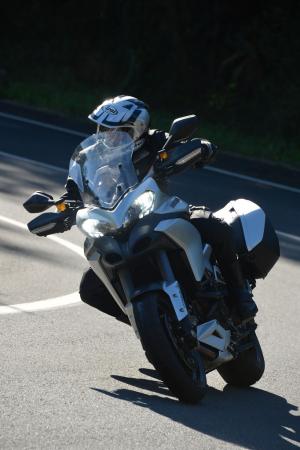
2013 Ducati Multistrada 1200S TouringThe Multistrada 1200 S Touring can be had in traditional Ducati red or the matte silver of our test bikes. Note the windshield in its raised position.
2013 Ducati Multistrada 1200
Ducati invented the Skyhook name for an imaginary fixed reference point above the bike acting like a hook in the sky. That sounds like the product of marketing men, but a more apt description is comparing DSS to an autofocus camera versus a manual one, as each riding mode has settings appropriate for each of the four-bikes-in-one riding modes. Or, like another famous marketer once said, “Just set it and forget it!”
If you prefer further customizing your ride, both compression and rebound damping can be individually altered to one of five positions. If that sounds like a small range of adjustment, you’d be forgetting about the automatic damping circuits that actually yield a wider range of settings than a conventional adjustable suspension. Interestingly, damping is at its firmest when the key is switched offRear preload is four-position adjustable at the push of a button, as on the previous Ohlins DES system, to suit varying loads. Front preload must be adjusted manually from atop the right fork tube.
The Proof Is In the Ride Pudding
To test out the new MTS, Ducati invited us to sample the S Touring model in the hills and picturesque coastline surrounding Bilbao, Spain.
2013 Ducati Multistrada 1200 BeautyBilbao, Spain made a nice backdrop for the 2013 Multistrada launch. The wild Frank Gehry-designed Guggenheim museum (former home of the “Art of the Motorcycle” exhibition) is visible on the left.
Sidling up to the row of Multis, not much seems new except for the “matte chrome” paint finish that appears both classy and sporty. Hidden saddlebag mounts ensure a clean tail end when not using the bags, and the new wheels look cool, especially the right-side rear that is exposed by the single-sided swingarm.
The enlarged storage bin on the right side of the cockpit has a push-style latch that replaces a troublesome slider latch previously used, and it’s a convenient place to stash the key fob that uses a proximity sensor to enable keyless ignition. An optional Garmin GPS is powered by a factory-supplied wire, augmenting the two 12-volt sockets located below the seat. Both hand levers are adjustable for reach. 2013 Ducati Multistrada 1200 OverheadFirst impressions are of a very narrow waist, especially for a sport-touring-esque rig. The first bike I rode was fitted with an optional low seat that makes 6.7 inches of suspension travel 1-inch easier to manage for short legs than the stock seat placed 33.5 inches high. The low version is standard in Asian markets and is a good choice for shorter riders, but larger pilots might find the rear section tilts upward uncomfortably.
Scrolling through the ride modes and DTC settings is initially frustrating, as the system (controlled by switches on the left handlebar) isn’t particularly intuitive. That said, any owner will be able to figure them out after some miles in the saddle.
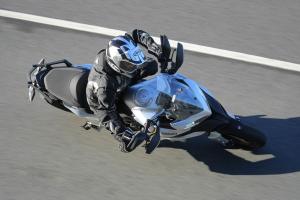
It didn’t take traveling more than a few feet to notice the revised engine’s user-friendlier power delivery at low revs.  The 90-degree V-Twin now pulls cleanly from as low as 2500 rpm, making urban crawling much more pleasant. At 494 pounds wet, the Multistrada is a relative lightweight in the sport-touring ranks, and its wide handlebar and sporty steering geometry enables quick reactions to scythe up traffic or a twisty road.
The efficacy of the Multi’s new windscreen was put to the test on a freeway section. It’s now 18mm taller, which helps deflect some wind over a rider’s body, but it’s the 43mm of extra width that notably improves airflow deflection, even if not to the barn-door levels of some sport-tourers.
2013 Ducati Multistrada 1200 FrontMore impressive is the brilliantly simple windscreen adjuster that can be operated with just one hand while riding. Greater wind protection is available with the screen in its uppermost position, but I enjoyed the non-turbulent air deflected when at the screen’s lowest position. Long-haul comfort is good, with an ergonomically satisfying rider layout that puts zero strain on wrists and provides generous legroom. Tall riders might find the seat to be a bit short front to rear, which reduces butt-position options.
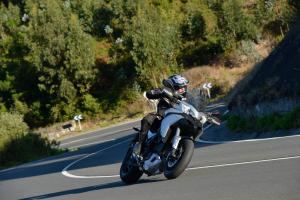
Bilbao was drenched with rain the night before our ride, and the roads remained damp during the morning portion of our ride. This gave a good test for the Ducati Safety Pack, which really aided rider confidence on the unfamiliar wet roads. In Touring mode, DTC’s default setting is level 5, and it makes throttle reapplication in a corner stress-free.
Also aiding rider confidence is the engine’s newfound smooth response at the low end of the bar-graph tachometer. With the old bike, I’d be feathering the clutch to tame its lumpy low-end reaction on damp surfaces. This added bottom-end smoothness also significantly widens the engine’s powerband, allowing it to pull cleanly out of tight corners even in second gear. On that subject, the Multi’s gearbox isn’t what you could call slick, although the bikes had less than 400 miles and not once was a shift missed.
2013 Ducati Multistrada 1200 SDamp corner exits are no match for the Multistrada’s traction-control system and the V-Twin’s newfound gentleness at low revs.
Once in the twisty sections of our ride, I switched to Sport mode and noticed sharper yet still quite manageable delivery of power from the V-Twin. The extra punch in the upper midrange enabled second-gear wheelies anytime they were asked for. Pirelli Scorpion Trail tires, with a dual-compound 190/55 on the rear, offer solid grip and the open tread-block pattern that enables light off-roading.
2013 Ducati Multistrada 1200 WheelieThe Multistrada’s eager and torquey V-Twin is a willing accomplice when practicing your hooligan maneuvers.
I was so tuned in to the revised motor and new windshield that I had almost forgotten about the Skyhook suspension. Then I realized that it had offered a plush ride on the highway, yet it also delivered superbly controlled suspension when ridden like a sportbike. Previous Multistradas, and indeed almost any long-travel bike, suffered a considerable amount of front-end dive when on the brakes, but Skyhook does an amazing job of limiting longitudinal forces that can make A-T bikes squirrely during hard deceleration. Automatically tightening up the front compression and rear rebound damping when braking kept the Multi amazingly stable, especially in Sport mode.
Speaking of brakes, the Brembo/Bosch combo is as good as it gets in this category. Radial-mount two-piece calipers up front deliver strong power without feeling too touchy – perfect for a streetbike. And no need to fear the linking effect when grabbing the front lever, as its influence on the rear binder is basically imperceptible.
2013 Ducati Multistrada 1200The Mulistrada’s somewhat odd appearance has become more mainstream over the years.
Almost lost in the DS and Skyhook spotlight are the amazingly bright LED headlights underscored by the LED position lamps which are nearly impossible to miss when pointed in your direction. Same for the LED signals in the handguards.
Conclusion
We already were big fans of Ducati’s liquid-cooled Multistrada, and the changes for 2013 significantly ups its appeal as both a sportbike and a touring sled. The semi-active suspension is a real advancement that will soon spread to many other motorcycles, and the smooth responsiveness of the new DS engine eliminates the biggest concern we had with the previous bike. So good is this new bike that I’d feel disappointed if I had recently purchased a 2012 MTS.
2013 Ducati Multistrada 1200 SThe Multistrada offers a combination of capable commuter, touring talent and backroad blitzer that is unique in the motorcycle world.
Negatives are few and far between. The centerstand tang interferes with your left heel when riding on the balls of feet, and the short sidestand causes the bike to lean far over when parked. The package could be improved by the addition of TFT instrumentation and cruise control, but these are minor annoyances rather than deal breakers. 
In our Best of 2010 Awards, we observed the Multistrada “has the best combination of sport, touring and commuting that we’ve ever experienced, potentially paring down a three-bike garage to just two wheels.
The above statement holds even more water with the introduction of the 2013 Multistrada. The only impediment to your consideration might be the $17K entry price. The updated ’Stradas will be available in North America early in 2013.
2013 Ducati Multistrada 1200 Water ViewThe Multistrada can ably take you to roads both near and far.

Ducati Diavel Cromo 2012 Review

Who knew Lucifer to be such a haute-couture sumbitch. A half-dozen years ago his alias was associated with Prada via Meryl Streep, and now its resplendent on the air intakes of a motorcycle manufactured by one of our industry’s designer name brands. Got to admit, though, pronouncing Diavel sounds way cool (dee-ah-vehl), and just knowing the Bolognese word for devil has expanded my vocabulary to include more than a few Italian motorcycle terms and the names of Americanized spaghetti sauces. 
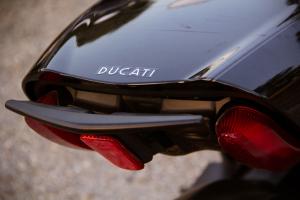
Ducati recategorized the power-cruiser market with the Diavel, taking the fight to YamaStar’s venerable VMax (stay tuned for our forthcoming shootout), but the Cromo version seen here only ups the fashion ante. Divorced from function or performance, higher fashion commands a higher price and that applies to the Cromo model. The Cromo is one step above the standard model. Retailing at a $1500 premium over the regular Diavel, the Cromo ($18,995) is outfitted with a bevy of cosmetic accoutrements. Most noticeable are the chrome-finished tank panels embossed with Ducati's vintage Meccanica logo and the word Cromo laser-etched into the air ducts on either side of the tank. A seat cover streamlines the pillion saddle, while the paint's gloss-black finish is highlighted by silver pinstripes on the front fender, fuel tank, headlamp nacelle and seat cover. Horizontally ribbed seat stitching gives a custom appearance.

The standard Diavel is available in a similar Diamond black color scheme for the same seventeen-five price tag, but a Cromo it is not. The Cromo ranks fourth in the Diavel line, behind the  AMG ($26,495) and the Carbon ($19,995). In any guise, the Ducati cruiser is a bike unlike any other.
"The Diavel is surprising in so many ways,” says grand poobah, Kevin Duke. “It looks huge but feels small and has a caricaturish fat rear tire yet is amazingly agile.” To which senior scooter editor, Troy Siahaan, adds “Its stance is pretty badass, menacing, aggressive and mean, just as a bike in this category should be.”
Sitting dormant the Diavel could be construed as more form than function, but how lame would a title like Devil be if that were the case? This is Ducati after all, a manufacturer with a reputation for performance. With the key fob close by, flip up the red kill switch and push the starter button and Diavel belches (legal decibel level) hellfire from its 58mm cross-section exhaust headers and dual stacked shorty mufflers.
“Ducati exhaust notes are almost always delicious, and the Diavel continues that tradition,” says Duke. “It emits a tough and nasty bark befitting its muscle-bike persona.”
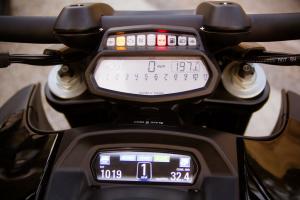
2012 Ducati Diavel Cromo CockpitRiding the Diavel conjures a mixture of sensations. Hell, just sitting on it can be perplexing. “I'll admit it was weird to place my feet in front of me on a Ducati. That's something I've never done before,” remarks Siahaan.


Motion exposes Ducati’s go-fast intentions, and for the Diavel, that begins with the motor. Strapped to Hypercycle’s dyno the Cromo produced 134.5 rear-wheel horsepower at 9400 rpm and 80.1 ft.-lb. of torque at 7900 rpm from its Testastretta 11° engine. Twist a handful of right grip and the deeply curved seat immediately makes sense. While it tends to lock its rider into a single position, the backstop it provides when unleashing the engine’s potential is welcome support considering the bike’s upright seating arrangement.
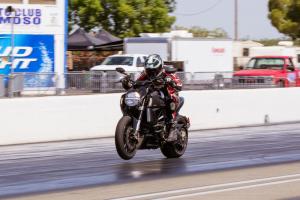
In the hands of MO’s dragstrip specialist, Duke put the Diavel through the lights at Famoso Dragway outside Bakersfield, California, in a very respectable time of 10.32 seconds at 131.29 mph. Corrected for temperature and air pressure, the ET converts to a seriously quick 9.95-second pass. Yes, we did run the Cromo against the VMax but we’re withholding that information for our upcoming shootout between these muscle-bike beasts.
On the street and in the corners the Diavel Cromo blurs the lines between cruiser and sportbike. “Despite its cruiser pretense, this is one factory custom that doesn't need to shy away from a twisty canyon road,” Duke says. Despite its conservative rake and trail figures and its wide swath of rubber out back, initial lean-in is easy to achieve, but it’s leveraging that 240mm wide tire to its edge that’s trying.
2012 Ducati Diavel Cromo Drag Race“When you get it leaned over, the front feels like it's going to slide out from under you,” says Siahaan. “It won't, but you have to slowly work up to that level of trust with the Diavel.”
Another eminent performance attribute are the Diavel’s brakes. “Its Brembos are notably strong, but their initial bite might be a little too abrupt for anyone accustomed to typical cruiser brakes,” notes Duke.
2012 Ducati Diavel Cromo Passenger Grab HandleIncluded in the Cromo’s asking price is an array of electronic gadgetry such as ABS, DTC, riding modes and ride-by-wire throttle, while suspending the bike is a fully adjustable 50mm Marzocchi fork and a Sachs progressive linkage monoshock, both fully adjustable. As mentioned earlier, these components are identical to those on the lesser expensive standard model Diavel.
For a more detailed assessment of the Diavel’s performance read Pete Brisette’s full review, and stay tuned for our forthcoming shootout against the VMax.
For now, Duke sums the Diavel up best, saying it “impresses as much for what it isn't than what it is. It's not a typical cruiser nor is it a typical Ducati but a hybrid of cruiser and sportbike that delivers a pleasingly unique riding experience. There’s nothing else quite like it.”
2012 Ducati Diavel Cromo Left Side

Ducati Diavel Cromo Specs
Engine
TypeTestastretta 11°, L-Twin cylinder, 4 valve per cylinder, Desmodromic, liquid cooled
Displacement1198.4cc
Bore x Stroke106 x 67.9mm
Compression Ratio11.5:1
Power162hp (119kW) @ 9500rpm (claimed at the crankshaft)
Torque94lb-ft (127.5Nm) @ 8000rpm (claimed at the crankshaft)
Fuel InjectionMitsubishi electronic fuel injection system, Mikuni elliptical throttle bodies with RbW
ExhaustLightweight 2-1-2 system with catalytic converter and two lambda probes. Twin aluminium mufflers
Transmission
Gearbox6 speed
Primary DriveStraight cut gears, ratio 1.84:1
Ratio1=37/15 2=30/17 3=27/20 4=24/22 5=23/24 6=22/25
Final DriveFront sprocket 15; Rear sprocket 43
ClutchLight action, wet, multiplate clutch with hydraulic control. Self-servo action on drive, slipper action on over-run.
Chassis
FrameTubular steel Trellis frame
Front SuspensionMarzocchi 50mm fully adjustable usd forks
Front Wheel14-spoke in light alloy 3.50 x 17
Front Tire120/70 ZR 17 Pirelli Diablo Rosso II
Rear SuspensionProgressive linkage with fully adjustable Sachs monoshock. Aluminium single-sided swingarm
Rear Wheel14-spoke in light alloy 8.00 x 17
Rear Tire240/45 ZR17 Pirelli Diablo Rosso II
Front Wheel Travel120 mm (4.7 in)
Rear Wheel Travel120 mm (4.7 in)
Front Brake2 x 320 mm semi-floating discs, radially mounted Monobloc Brembo callipers, 4-piston with ABS
Rear Brake265 mm disc, 2-piston floating calliper with ABS
InstrumentationHandlebar mounted instrumentation with LCD display: speed, rpm, time, coolant temp. Warning lights for: Neutral, turn signals, high-beam, rev-limit, DTC intervention, ABS status, oil pressure, fuel reserve. Tank mounted instrumentation with TFT colour display: gear selected, air temp, battery voltage, trips 1 & 2, fuel reserve trip, average and actual fuel consumption and speed, trip time, scheduled maintenance. Full status and/or management of Riding Modes, DTC, RbW and ABS.
Dimensions and Weight
Dry Weight210 kg (463 lb)
ABS Wet Weight239 kg (527 lb)
Seat Height770 mm (30.3 in)
Wheelbase1590 mm (62.6 in)
Rake28°
Trail130 mm (5.12 in)
Fuel Tank Capacity17L - (4.5 US gal)
VersionsDual seat
Standard Equipment
Standard EquipmentRiding modes, ABS, DTC, RbW
Warranty
Warranty2 years unlimited mileage
Maintenance Service Intervals12,000 km (7,500m)
Valve Service Check24,000km (15,000m)
Emissions And Consumption
StandardEuro 3

Ducati 1199 Panigale 2012 Review

When a motorcycle company starts with a clean-sheet design, there are so many ways to go wrong. Often it’s best to wait for Version 2.0. But Ducati has knocked one out of the park with its sensational new 1199 Panigale, the first ground-up mass-production model from Ducati since the 1979 Pantah.
While a definitive verdict will have to wait until we test the 1199 on home soil, our short time aboard it at the fantastic Yas Marina Circuit in Abu Dhabi was enough to confidently predict the Panigale is one of the finest sportbikes ever made and is a leading contender for our annual Motorcycle of the Year award.
There is no area of performance it doesn't excel in – power, handling, braking, electronics. It has everything you could want in a modern liter-sized sportbike, including sharp styling that blazes a new design trail. Compared to the outgoing 1198, the Panigale rocks 25 extra horsepower while weighing 22 lbs less.


Tech Mate
Ducatis have long been known for sexy Italian style, but rarely for implementing cutting-edge technology. The Panigale blows that perception away.
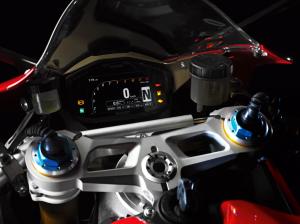
2012 Ducati Panigale GaugesKey to its design is its unique monocoque frame which uses the V-Twin engine as a major component of its chassis. A cast-aluminum section weighing just 9.3 pounds provides the steering-head support for the fork and, like clever engineering solutions, also doubles as the engine’s airbox and aluminum fuel tank base. The alloy structure bolts to the engine for the chassis’s core composition, simple as that. Supporting the seat and tailsection is another lightweight (just 4.6 pounds) aluminum piece that bolts to the engine’s rear cylinder and rear edge of the steering box. A magnesium structure up front weighs just 1.3 pounds and supports the upper fairing, headlights and gauges.
Standard equipment on the $17,995 Panigale includes multi-level traction control, three riding modes (Race, Sport, Rain) that vary throttle response via the ride-by-wire throttle, Ducati’s Quick Shifter and a new-for-2012 Electronic Braking Control.
The upmarket S version ($22,995) brings higher levels of specification, upgrading from Marzocchi and Sachs suspension to electronically adjustable Ohlins components. Each riding mode has default compression and rebound damping settings which can also be tweaked individually by pushing a few buttons on the left-hand switchgear while navigating the wonderfully legible TFT instrument panel. Also on the S is the industry’s first LED headlight.
2012 Ducati Panigale Profile RightTop of the Panigale range is the Tricolore version that includes ABS, Termignoni mufflers and a GPS-equipped DDA+ data acquisition unit that automatically logs lap times and draws circuit maps.
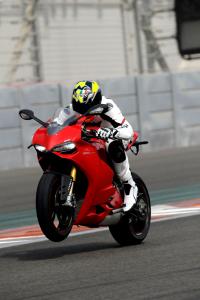
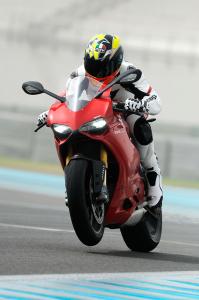
Let’s Ride!
Unlike any of the dozens of racetracks I’ve been to, the 3.45-mile Yas Marina Circuit is accessible by walking directly from our hotel, the visually spectacular Yas Viceroy, to the same paddock that annually hosts the exclusive Formula 1 series. Ready in the garage is a phalanx of gleaming red 1199 Panigales that appear even more sinister than they look in pictures. They come across as chic and contemporary but without being derivative of anything else. Even my mom, who had her 77th birthday on my ride day and dislikes motorcycles, would be able to recognize the Panigale is a special machine.
Anyone who’s thrown a leg over Ducati’s 1098/1198 models will be pleasantly surprised by the 1199’s revised ergonomics. It’s seat is moved more than an inch closer to the handlebars, and the bars are raised 10mm, which add up to a layout much less stretched and significantly more comfortable. Slinging a leg over its diminutive tailsection is easier than the 1198’s that had two heavy exhaust canisters stuffed under it. The Panigale has its mufflers placed under the engine, Buell-like, for mass centralization. Its seat is said to be at 32.5 inches but seems lower, and its tank feels nicely narrow between the knees.
Thumb the starter button and the 1199cc V-Twin comes to life with an authoritative bark. A clever, cam-mounted decompression device allows a much smaller starter motor and battery, saving 7.3 lbs of weight. A twist of the throttle has the massive 4.41-inch pistons rising in revs quicker than the 1198 and makes its rider smile to the angry exhaust note. The new wet clutch has a moderate pull and engages without the grabbiness of the former dry design.
2012 Ducati Panigale GroupPulling the throttle hard at 5500 rpm is a little disappointing compared to the 1198’s lump, as the most oversquare bore/stroke ratio of any production motorcycle would lead one to think. But the mild disenchantment is entirely forgotten once past 7500 rpm when the Superquadro engine piles on revs with ferocity previously unknown from any V-Twin.
Peak torque arrives 1000 rpm later than the 1198 at 9000 rpm with a stonking 98.1 ft-lb of force (measured at its crankshaft). From there, horsepower builds viciously to its 195-horsepower climax. It’s worth noting the Panigale’s rating is a pair of ponies more than BMW’s scintillating S1000RR, although we’ll have to strap it to a dyno to prove if its horsepower actually reigns supreme.
2012 Ducati Panigale WheelieThe Superquadro’s love for revs is distinct from any other liter-size Twin. Significantly larger intake and exhaust valves, still desmodromically actuated but now with titanium intakes, let the engine breathe in the upper revs allowed by the short-stroke design, screaming all the way to 11,500 rpm. The 1199’s engine designer, Marco Sairu, says the Panigale’s ultimate piston speed of 22 meters/second is nearly identical to the four-cylinder S1000RR. Despite all this new performance, a switch from rubber cam belts to a chain-and-gear cam drive nearly doubles valve adjustment intervals to 15,000 miles.
My first session on track was spent in the ECU’s Sport mode that enables all 195 horses but with suppler throttle response than in Race mode. The Panigale’s ride-by-wire throttle allows the two fuel-injecting throttle bodies to operate independently, using computer brain-power to best deliver what a rider’s wrist is asking for. There are two injectors in each throttle body, the one closest to the intake tract employed at lower revs, while the upper showerhead-style injector engages at high rpm.
2012 Ducati Panigale Action FrontThis sounds more HAL 9000 than it feels, as response from the throttle is surprisingly direct and intuitive. Reaction in Race mode is quite a bit sharper than in Sport but still quite manageable. A secondary-air system can inject air into the exhaust ports for more complete combustion, allowing a richer intake charge while still meeting emissions regs and eliminating the on-throttle abruptness caused by lean mixtures.
After becoming accustomed to the Superquadro’s gobsmacking top-end wallop, I realized the Panigale is undoubtedly the most agile Superbike-series Ducati ever made. Rake remains at 24.5 degrees while trail is lengthened a nominal 3mm to 100mm. Despite a traction-enhancing longer (by 1.53 inches) swingarm, the 1199’s wheelbase is up just 7mm thanks to Sairu’s thoughtful tight arrangement of transmission gears.
Regardless of the barely altered geometry, the Panigale responds with eagerness the 1198 could only dream of. It’s less unwavering than the freight-train-like 1198 but not unstable. Its enthusiasm to tip into corners is due in large part to its higher and 1.26-inch wider handlebars that deliver more leverage, but credit also its lighter weight (415 lbs with its larger fuel tank full) and mass-centralization efforts that lower the inertia moment around its roll axis. Also, the S version of the 1199 we tested is shod with lightweight forged and machined Marchesini wheels that are nearly 1 lb lighter than the forged wheels on last year’s 1198SP.
2012 Ducati Panigale CorneringThe Panigale’s nimbleness was a welcome surprise through Yas Marina’s chicanes.

But there’s more to judging a bike’s handling than just fervent tip-in behavior, and the Panigale’s mid-corner feedback and composure also impress. Its weight distribution of 52/48 F/R is identical to Ducati’s World Superbike, and is advantageous for front-tire loading as compared to the previous 50/50 balance. The ergo layout makes it easy to hang off in corners.
It was a windy day in Abu Dhabi, bringing in an unwelcome dusting of sand on the track. Clouds of rooster-tails burst from the tires of bikes ahead and brought major anxiety for adhesion levels. But a combination of a grippy track surface from aggregate shipped in from England to pave the track plus Pirelli’s excellent Supercorsa SP street tires yielded much more traction than expected. The rear Pirelli’s size is the new 200/55-17, and its 24% larger naked (no tread) edges feature a softer compound to provide tenacious grip. The front donut is molded with a single compound in a traditional 120/70-17 spec.
2012 Ducati Panigale Action RightNo need to worry about the efficacy of the monocoque chassis design.
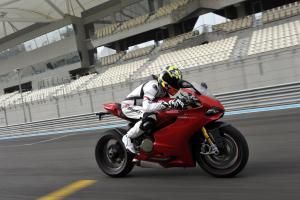
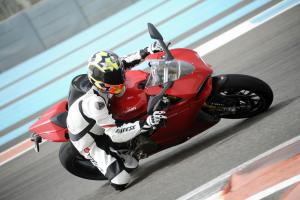
Strong drive out of corners is aided with the safety net of an updated version of Ducati Traction Control available in eight settings. I rode most of the day in Race mode which has a default DTC setting of level 3, and it proved to be unobtrusive and engaged discretely.  An orange light at the top of the gauge pack shows when it’s cutting in. If you’re TC-phobic, it can be completely switched off.
2012 Ducati Panigale AerodynamicsHard on the gas, the Panigale hurls itself out of corners, piling on revs voraciously and demanding quick upshifts as indicated on the prominent sequential shift lights. Standard on all 1199s is the Ducati Quick Shifter which briefly interrupts the ignition to allow full-throttle clutchless upshifts. The bike gathers speed with S1000RR-like alacrity, pulling up its front wheel over a slight rise even when in fifth gear. At the end of Yas Marina’s 1.2-kilometer straight, the speedometer of the Termignoni and up-spec-kitted version I rode saw an astonishing 296 kph! That’s 184 mph for the metric-disinclined.
Bleeding off speed is the responsibility of a potent set of brakes. New Brembo M50 monoblock 4-piston calipers up front are 7% lighter than the 1198’s and are exclusive to the Panigale. Biting on 330mm discs, the petite clampers deliver a perfect blend of power and sensitivity. Lots of feedback encourages trail-braking to corner apexes, but the bike is modestly reluctant to tip in fully with the brakes still on, so it’s best to release them slightly before the apex.
2012 Ducati Panigale 1199We tested the optional Bosch antilock system that uses four channels of info (one at each master cylinder and one at each caliper) for the utmost in precision. Forget whatever you thought you knew about ABS on a racetrack, as this is one smart and powerful system that gives up nothing in performance and adds only 5 lbs. Levels 2 and 3 link the rear brake to the front lever to varying degrees, but level 1 does not and disengages rear ABS to allow stoppies when braking hard.  And if you’re feeling brave, ABS can be disabled.
Fears of braking zones are also assuaged by the slipper function of its back-torque-limiting clutch and new Electronic Braking Control that cracks open the throttle butterflies when decelerating to reduce the engine’s compression-braking effect over three levels or disengaged entirely. I kept EBC on Level 1 and had no issues with the back tire dancing around during the hardest braking I dared to explore.
Yas Marina’s smooth surface did little to test the electronically controlled Ohlins suspension, but we’re confident the high-quality Swedish dampers are fully up to task. I didn’t touch the taut settings that are programmed in the ECU’s Race mode because they felt ideal.
2012 Ducati Panigale 1199 Action LeftOhlins electronically controlled suspension is standard equipement on the Panigale S. The NIX30 fork separates damping circuits, compression in the left and rebound in the right, and uses a slippery titanium-nitride coating for maximum responsiveness. The horizontally placed TTX36 shock features Ohlins twin-tube technology to separate its damping circuits, and its linkage can be configured in two settings: a progressive rate for street use or a flat-rate for racetrack duty.

Conclusion
To anyone noticing this has thus far been a sugary-sweet review, you might doubt this author’s objectivity. However, the Panigale really is this good. In fact, it’s the most impressive new sportbike I’ve ridden since the debut of Yamaha’s landmark R1 in 1998.
2012 Ducati 1199 Panigale Knee DownReaching for criticisms about the Panigale, its faired-in sidestand is hard to snag with the heel of a race boot.
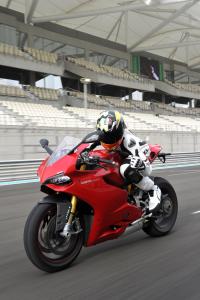
2012 Ducati 1199 PanigaleAs for negatives, they are few and minor. Its windscreen provides only modest protection, and its clutch pack sticks out far enough to interfere with a rider’s right calf when at a stop. Heat from the engine might be excessive when ridden at low speeds, though likely no worse than the 1198 and probably better.
Otherwise, the Panigale is a thoroughly entertaining superbike for the street with more technology than any sportbike on the market. Even its mirrors provide a moderately useful view, which is something unprecedented from Ducati’s superbike series.
Riders of diverse abilities were highly impressed with the Panigale. Rishad Cooper, our correspondent from India who rarely rides such powerful machines on a racetrack, had only glowing comments about the bike. At the other end of the spectrum is AMA Superbike racer Chris Ulrich, a guy typically not averse to speaking negatively about street-compromised bikes, who said he had no performance issues with the Ducati.
Simply put, Ducati’s Panigale astounded me with its sheer performance and its high level of refinement, plus it is mouth-wateringly stunning. The 1199 is a superb machine that had several jaded motojournalists considering buying one for themselves. It might even be the best sportbike ever made.

Duke's Duds
2012 Ducati 1199 Panigale
  • AGV Ti-Tech helmet
  • Dainese Laguna Seca Pro leathers
  • Dainese Pro Carbon gloves
  • Dainese TRQ-Race boots
  • Dainese Wave 11 Air back protector


Ducati 1199 Panigale "Superquadro" 2012 Engine Details

With so much hype surrounding Ducati’s 1199 Panigale – the successor to the 1198 superbike – we found it worthy to conjure up what we think the bike will be like in our 2012 Ducati 1199 Panigale Preview. We based much of that article around various sources, some of which are more reliable than others. And while much of what’s written about the 1199 and its architecture are simply educated speculations, yesterday Ducati released official information about the new game-changing powerplant, dubbed the “Superquadro” in anticipation of the model’s unveiling at EICMA next month.
It’s interesting to note that design sketches for the new machine began in 2008, the same year the much-heralded 1098R, which is essentially the same motorcycle Carlos Checa rode to this year’s World Superbike title, was released. It would seem logical then that the 1199 was at least a napkin sketch at the time of the 1098R’s unveiling. Having been at the world introduction of the 1098R, I can personally account for the buzz regarding it and its racing potential. To think that Ducati wasted no time drawing up its successor is a glimpse into the life cycles of design and how far forward manufacturers are thinking.


We stated in the preview story that the name stems from the engine’s highly oversquare bore and stroke dimensions. We guessed bore dimension correctly at 112mm, but were off just a tenth of a millimeter high in stroke dimension. In actuality it will be set at 60.8mm, for a bore/stroke ratio of 1.84:1. Such a short stroke length is needed in order for the engine to safely spin fast enough to produce the amount of power Ducati engineers felt would make it competitive against four-cylinder machines – a walloping 195 horses and 98 ft.-lbs (at the crankshaft), rates the factory.
Up Top
2012 Ducati 1199 Panigale Superquadro Engine Valves
We were slightly off in regards to the engine’s redline, as we predicted the Superquadro would spin to at least 12,000 rpm. In reality the rev limiter is set to kick in at 11,500 rpm. Still, that’s a big number for a Twin. Speaking of big numbers, if Ducati’s claim of 195 crankshaft horsepower is correct, that would make the 1199 Panigale the most powerful production V-Twin ever, even putting it directly on par with its Japanese – and German – four-cylinder counterparts.
It’s worth noting that, despite peak horsepower being reached at 10,750 just 750 revs short of redline, Ducati claims the Superquadro engine starts to surpass its 1198 predecessor at 8250 rpm.To handle such high stresses, intake and exhaust valves increase in size, 46.8mm (from 43.5mm) and 38.2mm (from 34.5mm), respectively. Both are also now titanium instead of steel (a method previously only used on “R” models) and are actuated by rocker arms coated in polymeric-like carbon (PLC), a process originally developed for the aerospace industry which greatly reduces friction (it’s a coating similar to the diamond-like coating seen on many high-performance fork stanchions).
An interesting trick Ducati has employed on the 1199 is the use of what they call an “auto-decompressor” to make the engine turn over with less effort from the starter. A flyweight at the end of each exhaust cam gear retracts at super-low speed to rotate a protrusion from the concentric side of the cam, thus creating just enough valve lift to relieve the pressure on the piston for easy startup. If you’ve ever had the pleasure of starting a Ducati, you’ve felt that anxiety just as you press the starter button as the engine struggles to turn over. The auto-decompressor alleviates that worry, and as a side benefit also allows the use of a much smaller (read: lighter) starter and battery.
2012 Ducati 1199 Panigale Superquadro Engine Piston and CamsThis CAD drawing reveals the desmodromic valve actuation and the chain/gear assembly that drives them. Note also the “auto-decompressor” on the end of the exhaust camshaft. It opens the valve slightly at tick-over to ease startup.
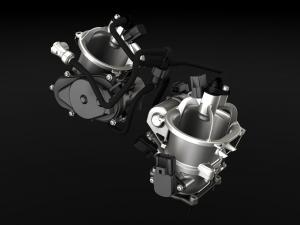
Of course, actuating those valves is none other than the desmodromic mechanical system Ducati has sworn by for ages. Now, with the higher engine speeds precise valve movement is more important than ever, and Ducati feels as though it’s situations like this that emphasize the importance of mechanical valve actuation over valve springs. However, instead of belt-driven camshafts, Ducati is bucking with tradition and relying on a combination chain/gear setup. According to Ducati, this is the best way to precisely control timing of the sharp cam profiles, especially at high rpm. As a side bonus, this also helps extend the length of routine service intervals. Now valve adjustments are required every 15,000 miles, with oil changes at 7500 miles (racetrack usage will shorten those numbers). Don’t expect to see this tech trickle down to air-cooled Ducs, however – those models don’t rev high enough to warrant a switch.
Down Low
2012 Ducati 1199 Panigale Superquadro Engine Injectors
With such large pistons spinning at high rpm, the Superquadro units feature double-ribbed undercrowns for improved strength and reduced friction. The correct combination of air and fuel is fed to these massive cylinders via equally massive throttle bodies, measuring an equivalent diameter of 67.5mm. For perspective, the 1198’s measure 63.9mm! Each throttle body is actuated electronically via Ride-by-Wire technology, and feeds two injectors; one underneath the butterfly for better low-speed response and one positioned directly atop for outright power. The use of Ride-by-Wire technology also enables the implementation of ride modes and traction control, but Ducati is keeping those electrical secrets close to heart until the bike’s unveiling.
As far as the architecture of the engine is concerned, the Superquadro retains the 90-degree L orientation as seen on all Ducati V-Twins, only this one is rotated backwards around the crankcases a further six degrees until the front cylinder is 21 degrees from horizontal. Apart from moving the front cylinder 32mm closer to the front wheel (compared to the 1198) and improving weight distribution, this also allows the proper positioning of the cylinder head attachment points for the monocoque frame. Inside the engine, vacuum die-casting technology first used on the 1098R is used again to save weight, ensure consistent crankcase wall thickness and increase strength. Another carryover material used on the 1199 is magnesium alloy for the primary-drive casing, clutch casing and outer cover, sump and cam covers. In our preview story earlier, we mentioned Bruno de Prato’s claim that Ducati was ditching the crankcase roller bearings that have been in use for over 20 years in favor of plain, or “shell” bearings currently employed by the Desmosedici RR engine in MotoGP. Turns out he was right. This enables larger diameter crank journals which makes for a more rigid and durable bottom end, suitable for the Superquadro’s power output. Bearings are force-fed oil from internal drillings within the main bearing pillars and that oil is sucked back into the sump via vacuum pump, technology taken straight from the MotoGP program. The pump is driven by the main oil-pump shaft and effectively maintains constant vacuum in the crankcase area below the pistons, reducing pressure during the cylinder’s down strokes and controlling the engine’s “breathing.”
2012 Ducati 1199 Panigale Superquadro Engine CrankcaseVacuum die-casting technology is used on the crankcase to ensure wall thickness, save weight and increase strength. It’s a technology first used on the 1098R.
And while we’re on the subject of breathing, Ducati was able to achieve this power while still meeting ever-stringent emission requirements. One of the methods of achieving this is the introduction of a secondary air system that helps complete the combustion of unburned hydrocarbons. Through the use of lambda and throttle position sensors, the ECU detects specific conditions and, if needed, opens a valve in the main airbox to a reed valve in each cylinder head. Ultimately, this fresh air is routed to the exhaust valve at its hottest point, enhancing the burn environment and combusting any unburned fuel.
Attention wasn’t just given to the engine, however. An all-new gearbox features stronger, larger-diameter gears to cope with the increase in power. A bigger shock is Ducati’s switch to a “wet” oil-bath clutch after years of sticking with the dry clutch design. The design is based closely on the Multistrada and Diavel units and features a slipper function to prevent wheel-hop under hard braking or quick downshifting.
2012 Ducati 1199 Panigale Superquadro GearboxAn all-new transmission is mated to the Superquadro engine utilizing stronger, larger-diameter gears to withstand the increase in power. Interestingly, in the interest of weight and optimal stiffness, Ducati chose not to equip the 1199 Panigale with a cassette-type transmission.
Too Slow. Not.
Apart from the above information, here are some other interesting tidbits about the Superquadro. First seen on the the 1200 Multistrada and new 848 Streetfighter, Ducati utilized an 11-degree valve overlap to maximize torque output at the expense of top-end power. With the Superquadro, however, a 45-degree overlap is used to squeeze out every last bit of power.
Overall, the dimensions of the Superquadro engine are more compact than the 1198, though it’s slightly taller due to the deeper oil sump needed for heavy braking. Direct weight comparisons between old and new are harder to measure, as the new powerplant is reinforced in order to handle the increased demands of being the main stressed member of the monocoque chassis. Ducati insists on measuring the overall weight of the complete motorcycle, which it claims will be lighter than the outgoing 1198.
2012 Ducati 1199 Panigale Superquadro Engine Vacuum PumpThe Superquadro engine features a vacuum pump driven by the oil pump shaft, a trick used in MotoGP. This pump maintains constant crankcase vacuum below the pistons, which helps the engine “breathe.”
Despite the MotoGP team experimenting with seamless shift technology, Ducati denies that this was even considered in the design of the 1199 Panigale. The company also denies even considering the use of a V-Four engine configuration like rival Aprilia and the RSV4 Factory. According to Claudio Domenicali, Ducati General Manager, “We still consider the Twin the best option when you come to offer the ‘Ducati feeling,’ which is strongly based on light weight and torque.”
And to answer a question many are surely wondering, Ducati denied the prospect of the Superquadro engine being used on future models. Seeing as how it serves as the main stressed member of the frame, that would mean future Ducatis would also need to be completely redesigned to support a monocoque chassis. Possible? Sure. Likely? Probably not. But when it comes to the folks in Borgo Panigale, one learns to never say never.
01SQ_motor_45_white_192012 Ducati 1199 Panigale Superquadro EngineDucati claims the new Superquadro engine is more compact than that of the 1198, though the deep oil sump of the Super-Q makes it taller than the 1198 mill.
As we mentioned in the beginning, complete details about the rest of the 1199 Panigale will be revealed at the EICMA show in Milan next month.

Ducati 848 Streetfighter 2012 Review

With the world launch of the 1199 Panigale superbike at the EICMA show in Milan still a month away, Ducati filled the interim with an international press launch of the 2012 848 Streetfighter. The combined street and track ride in and around Modena, Italy, exposed the newest naked performer to Sunday morning twisties and trackday duties.
Nearly identical in appearance to the larger 1098 Streetfighter, the new 848 is meant to provide motorcyclists a more affordable and less extreme option to the superbike-powered S model, which is the only other Streetfighter available for 2012 as the standard Streetfighter is being discontinued.
The most obvious difference between the two 2012 Streetfighter models is engine displacement. Whereas the Streetfighter S utilizes Ducati’s 1099cc L-Twin cylinder engine producing a claimed 155 hp and 89 ft.-lb. of torque at 9500 rpm, the new Fighter is powered by an 848cc Twin outputing a claimed 132 hp and 69 ft.-lb. of torque at 10,000 and 9500 rpm, respectively. Producing its peak horsepower 500 rpm higher in the rev range and with a compression ratio of 13.2:1, compared to the S’s 12.5:1, the new SF is a little more high-strung than the larger-displacement model.


Ducati’s crankshaft-derived power figures will decrease when run on a rear-wheel dyno. The 848 Superbike is factory-rated at 140 hp, 8 up from the new Streetfighter due to slightly less valve lift and duration, and it produced 119 hp on the Superflow dyno at Mickey Cohen Motorsports during our middleweight sportbike shootout. Thus, we expect the 848 SF to generate a little over 110 ponies at the rear wheel.
This amount of power is plenty fun and exciting on a bike weighing approximately 410 pounds full of fluids. On the street there’s enough oomph for any situation, whether it be wheelieing or passing, while on the track the 848 Fighter will make easy work of better bikes with lesser riders.
Set to retail at $13,000, the 848 Streetfighter is substantially more affordable than the $19,000 Streetfighter S but only $2000 less than the soon to be nonexistent $15,000 standard Streetfighter (hurry and get yours now if you perceive the standard 2011 1098 Streetfighter a better value). The 848 does retain Ducati Traction Control, which is a commendable technology to be included at such a low MSRP.
The bigger Streetfighter S model, in addition to the increased power of the larger engine, boasts an Ohlins fork whereas the 848’s front legs are of the Marzocchi variety. Both suspension components are fully adjustable and measure 43mm in diameter. The 848’s front end, however, is steeper than the S with 24.5 degrees of rake compared to 25.6 degrees on the S model. The 848 also has less trail than the S, 103mm vs 114mm, respectively, but the wheelbase of both bikes remains identical at 58.1 inches.
Whether on the street or the track the Streetfighter takes some time for the bike to feel comfortable and/or familiar. The front end on the 848 version as well as the 1099cc original can feel a bit twitchy, especially when leaned into a corner, and trail braking doesn’t come naturally when riding the Streetfighter. With the 848 spanning the same distance between contact patches as the S model but with a steeper rake and less trail suggests that Ducati may still be searching for a better base setup — which if achieved would go a long way in making the bike more inviting — but neither measurement lends itself to improved confidence.
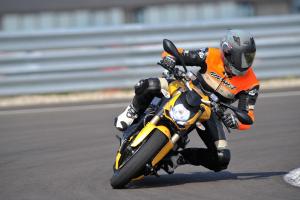
2012 Ducati 848 StreetfighterUsually less rake and more trail would help calm down a nervous front end, so Ducati’s unconventional approach of more rake and less trail to apply calm is interesting. Without a 1098 Streetfighter to ride for comparative purposes at the event, it’s hard to say if the change in front end measurements are better or worse, with the issue still persisting, though, it’s definitely not solved.
It wasn’t until the second session on the track that I was riding comfortably fast, pushing the Streetfighter closer to the edge of its performance envelope. The front end’s nervousness and higher handlebars dictate a light touch — ham-fistedness results in a wondering front wheel.
2012 Ducati 848 Streetfighter
Other significant differences of the 848 SF include a wet rather than dry clutch and new 10-spoke wheels instead of the five-spokers on the S. The tapered aluminum handlebars of the 848 are also 20mm higher than those of the S model. The high seat height of the S, 33 inches, carries over to the new 848, as do the slippery footpegs.
The majority of these changes comprise to make the new 848 Streetfighter a better companion to the motorcyclist who is more concerned with the competency of the Streetfighter as a usable streetbike and less about the upgraded performance of the S model.
The higher handlebars, for instance, relieve some of the pressure on a rider’s wrists allowing for more time spent in the saddle. Because Ducati didn’t go as far as to change the seating position itself, this extra leverage is oftentimes put to use maintaining a comfortable distance between fuel tank and crotch. The combination of a very narrow tank/seat junction and downward sloping seat can make bumpy road riding a testicle-harrowing experience.
2012 Ducati 848 StreetfighterLight weight, wide bars and a narrow mid-section make the 848 Streetfighter easy to transition from side to side.
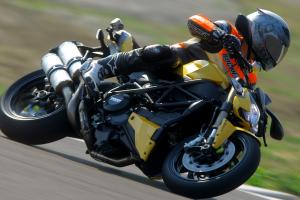
On a smooth, closed course racetrack such as the brand new Autodromo Modena (the 848 Streetfighter press intro was the track’s first official function) the narrow seat/tank juncture allows for quick, side-to-side transitioning.
Complaints were made of the original Streetfighter that a rider’s right ankle was forced uncomfortably away from the bike due to an exhaust heat guard. Ducati addressed this on the 2012 848 SF by adding a 10mm spacer to the right footpeg. Yes, the ankle no longer feels at an odd angle, but the modification did take away a degree of lean angle on a bike that has riders touching toe sliders to tarmac in concert with placing a knee on the ground.
The twin front, radially-mounted Brembo brakes and 320mm discs provide good braking power and didn’t fade during our two track sessions, but feel at the adjustable lever is a little vague.
2012 Ducati 848 StreetfighterAt the rear of the bike a fully adjustable Sachs shock attaches to a cast aluminum single-sided swingarm. The 5.5-inch rim holds a new 180/60 ZR17 Pirelli Diablo Corsa tire. The new size tire provides a wider contact area over its radius, and Pirelli claims improved damping capabilities to provide a smoother ride. Boasting a World Superbike compound on the right and left sides, the tire’s traction was never in question.
The 848 Streetfighter will be available in Fighter Yellow, Ducati Red and Dark Stealth but in any color the bike remains a stunner. The aggressive sex appeal of this motorcycle is undeniable, and if you can manage its few foibles, the 848 Streetfighter should make for a wonderful companion.
With the exception of the uncomfortable tank/seat juncture, the seating position provides plenty of leg room and a respectable distance from seat to footpegs. The higher handlebars will help keep the weight of a passenger off the rider’s back and the increased distance of the footpeg alleviates discomfort of the rider’s right foot.
2012 Ducati 848 StreetfighterUnskilled riders on faster bikes will see a lot of this angle of the 848 Streetfighter.
I personally wouldn’t want to spend more than an afternoon on the Streetfighter, but for a motorcyclist looking for competent weekend carver and occasional track day tool the Streetfighter is all that in an attention-getting package.

Ducati Monster 1100 EVO 2011 Review

The Monster 1100 is the latest bike in Ducati's lineup to receive the EVO (Evoluzione Desmodue) up-spec treatment. With 246,483 Monsters sold since the model line’s 1993 debut, creating a model like the 1100 EVO seems a good way to kick off the 18th year of Monster production.
The big-bore naked Italian roadster has been a favorite of the staff here since it first appeared in 2009 as a replacement for the Monster S2R. The strong pulling power of the comparatively simple air-cooled two-valve engine and the overall excellent handling performance from the chassis are key qualities we’re particularly fond of in the biggest of the Monsters.
Now with a revised engine, new exhaust, tweaks to ergos, reduced weight and the addition DTC (Ducati Traction Control) and ABS as standard, there's even more to like about the biggest of the Monsters.


Monster EVOlution
Where do you start to improve a motorcycle without re-engineering it to the point of losing the original bike in the process? In Ducati's estimation, a useful enhancement to the engine is step one.
Changes to the air-cooled L-Twin include revised cylinder heads with reworked intake ports, inlet valves gaining 5% more lift, and exhaust valve lift increased by 4%. Top-end oiling is improved for better cylinder head cooling, and revised piston shape bumps compression to 11.3:1 from 10.7:1 on the previous Monster. Keeping the pistons spinning is a new, lighter-weight flywheel designed similarly to the flywheel in Ducati’s supersport 848.
An all-new 2-1-2 exhaust migrated from under the Monster’s saddle to the right side of the bike. Although the new exhaust bears more than a passing resemblance to the Diavel’s exhaust, according to Monster 1100 EVO Project Engineer Giuseppe Caprara, the systems are not the same.
What the Monster EVO does share with the Diavel is its “race-like” slipper clutch, which incidentally is not the same as the APTC slipper clutch in the Monster 696, 796 and Hypermotard 796.
Caprara also confirmed to me that it’s chiefly the reworked cylinder head that gives the Monster 1100 EVO a 5-hp gain over the previous model’s 95 hp at 7500 rpm (76 ft-lbs at 6000 rpm remains unchanged from the 2010 Monster 1100).
2011 Ducati Monster 1100 EVOConsidering we live in a world where literbikes make 200 hp at the crank, speed junkies may not get excited by a modest gain of 5 ponies. But what is noteworthy is that this new 100-hp figure allows the Monster 1100 EVO to lay claim to possessing the strongest Desmodue engine Ducati has ever created.
Not bad for applying a few strokes of the computer mouse to an oldie-but-a-goodie air-cooled Twin.
An inverted, fully adjustable 43mm Marzocchi fork replaces the Showa sticks on the ’10 Monster 1100, and a Sachs shock with spring preload and rebound damping adjustments keeps the back-end in check. New, lighter-weight 10-spoke wheels wear updated Diablo Rosso II tires. Pirelli Testing Manager Salvo Pennisi explained the Rosso front tire has improved grip for wet weather riding, while the redesigned dual-compound rear tire has improved braking performance, better grip at maximum lean and is longer wearing.
Without the previous model’s undertail exhaust system to contend with, Ducati gave the new 1100’s tailsection a cleaner appearance, and also gave passenger and rider footpegs separate mounts where the previous 1100 employed a single, large cast piece to which both peg sets were connected. And in the interest of improved rider comfort the 2011 model’s handlebar risers are 20mm higher than last year. A 31.9-inch seat height is the same as last year.
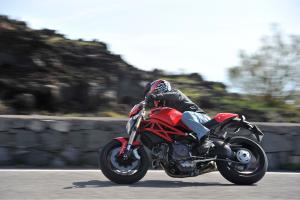
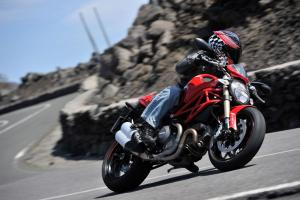
2011 Ducati Monster 1100 EVOThe Monster 1100 EVO has a rock-solid chassis that enables a rider to take full advantage of the bike’s 48-degree lean angle.
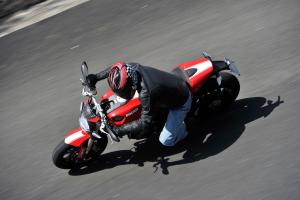
Lastly, the Monster 1100 EVO gets what Ducati calls the Safety Pack.
Standard issue for this Monster is ABS and Ducati Traction Control (DTC). This is the first Monster model to receive DTC. The DTC is somewhat tailored for this bike since there are four rider-selectable traction control levels rather than eight levels on other Ducati models equipped with TC. The fewer levels were simply a matter of tuning the TC to suit the Monster’s 100 hp engine, whereas the extra TC levels make more sense on the 150-ish horsepower 1198. The Ducati Data Analyzer (DDA) – you might utilize this feature to analyze lap times at the racetrack – is also available.
The Monster 1100 EVO has a claimed weight of 373 pounds, compared to the 377 pounds on the ABS-equipped 2010 Monster 1100 and 374 pounds on the Monster 1100S.
Monster impressions
Surface streets in the municipality of San Giovanni la Punta, Sicily (an enclave of sorts of the larger city of Catania of the province of the same name on Sicily’s eastern coast) are in about as good a shape as you should expect of such an ancient part of the world. Pavement on the narrow, winding streets is in decent condition, but there are nevertheless lots of chunked, cracked and patched sections of the streets.
It was while darting through these tiny corridors, like a rat avoiding the local Don, that I first started to appreciate how well the Monster’s stout new Marzocchi fork and Sachs shock gobbled up the broken and battered concrete. Both front and rear suspension were suitably damped for this type of urban assault, keeping the bike tracking true and me in comfort.
Our ultimate route was to climb a curvaceous road snaking its way out of the area of Zafferana Etnea and up the south side of the ever-smoldering Mt. Etna. At approximately 10,900 feet Etna is the largest active volcano in Europe and dominates the skyline over Catania. Ascending the serpentine, contorted ribbon of concrete presented a good opportunity to reacquaint myself with the Monster’s grunty engine.
Powerful torque, particularly noticeable starting around 4000 rpm and building all the way to the 8500-ish rev limit, develops in a deliberate but linear manner. This steady delivery of power proved useful for digging out of the numerous hairpin switchbacks that at times made the road seem as though it was layering over itself. It was also during the climb that I found myself cursing ever-stricter emissions regulations that have caused Ducati to burden the 1100 with gearing taller than I would like in cogs 2 and 3.
While torque is plentiful, run a gear too high while attempting to exit a slow speed corner and you’ll likely find the engine lugging and chugging. These less-than-ideal gear ratios aren’t limited to the 1100, as we’ve bemoaned tall gearing on the Monster 796 and Hypermotard 796, too.
2011 Ducati Monster 1100 EVO
After reaching the road’s highpoint we stopped for a cappuccino, café Americano, espresso or whatever injection of Italian water you like, at a café located in the alpine-like village of Rifugio Sapienza. Here, small roadside stands and average-looking shops sell the usual array of tourist-y trinkets, most of which are made from or have something to do with lava rock. The stuff’s plentiful, after all, since it covers much of the mountainside, creating a lunar landscape for mile after mile up and down the mountain.
If you’re really feelin’ your alpine oats, there’s downhill skiing action in Rifugio. Just don’t get disappointed by the single chairlift if you’re used to Summit County, Colorado.
After inhaling a couple of the best cannolis I’ve ever had, it was time to go down the mountain toward Nicolosi where the road straightens and re-enters city life. This portion of the ride, like the climb up, gave me new opportunities to assess different aspects of the new Monster’s performance.
2011 Ducati Monster 1100 EVOSteering ease, mid-corner stability, front-end feedback and overall chassis performance is excellent. The unflappable chassis inspires a rider’s confidence in the front-end, with the whole bike tracing an effortless arc ‘round each bend. The Monster 1100 EVO’s nimble but planted chassis (as well as the 696 and 796’s for that matter) is a genuine and defining strength of this Duc.
Since there’s so much loose, sand-like lava rock dust in certain spots, both going up and down the mountain, there were lots of chances for DTC to put itself in action. Level 2 seemed ideal for my riding, as it prevented spin up in low traction sitches (gravel, sand) but never struck me as overly intrusive. However, at low speeds, like when getting on the gas while pulling away from a stop in low traction conditions like gravel patches, even DTC Level 1 can intervene rather abruptly, to the point that the bike feels as though it's going to stall.
DTC access via a single Mode switch on the left-side switch pod – the same switch that also accesses all other settings in the LCD instrument panel – isn't intuitive enough.
It took several attempts to discern that holding the switch one way accesses a DTC submenu, and that changing DTC levels requires the switch move in the opposite direction. It takes some time to get the routine down, but once figured out the process is less complex. You can disable DTC altogether, and the system will retain its setting when the bike is switched off. The ABS system is also defeat-able but defaults to ON each time the ignition is turned on.
ABS, like DTC, is a good and practical feature, but the anti-lock system struck me as “first generation,” and not as refined as ABS on some current model sportbikes.
2011 Ducati Monster 1100 EVOA machine perfect for carving arcs in the mountains, the Monster 1100 EVO is equally at home pulling commuter duty. It’s both a great weekend play toy and urban-assault weapon.

At times the system produces some serious backpressure or “pump-up” when ABS activates. The sensation is that the Brembo radial master cylinder’s lever has stopped moving. This intermittent but funky feel is more profound at the rear brake pedal; it’s as if the pedal or lever has reached the end of its travel despite not actually doing so. Hard to say exactly what the ABS is or isn’t doing, but its as though the system isn’t opening and closing the control valve quickly enough to allow the brakes to apply and release as often they should.
To clarify, it took routinely aggressive application of the radial-mount Brembo calipers to get the ABS to act up; under normal use the system was trouble-free. And, in fairness, this delayed pulsing at the lever isn’t exclusive to the Monster 1100. I’ve had similar experiences on other ABS sets from different manufacturers.
The new back-torque-limiting clutch works well. Despite my best efforts to induce rear-wheel hop after rapid-fire, high-rpm downshifts, the clutch kept the gearbox from binding under engine braking. The slipper-style clutch and smooth-shifting 6-speed transmission performed on par with some of the best clutch/transmissions around – Japanese-bike-like, if you will.
Summary
The Monster 1100 EVO replaces the standard, as well as the Ohlins-equipped S model 1100, in the 2011 Monster lineup. While it usually isn’t good to eliminate choices for the consumer, all the updates on the EVO only serve to make a bike we liked before even better. Sweetening the deal is an MSRP of $11,995, the same price as last year’s base model.
2011 Ducati Monster 1100 EVODucati retained all that we liked about the previous model Monster 1100 in the new EVO 1100, and adds to it worthwhile updates and enhancements, while at the same time keeping consumers’ tightly held pocket books in mind. Grazie, Ducati!

 
Design by Wordpress Theme | Bloggerized by Free Blogger Templates | coupon codes