


 08:53
08:53
 Unknown

Honda is highly regarded as a leader in motorcycle technology. It shocked the world in 1969 with the introduction of the first large-displacement four-cylinder engine (CB750), and it was the first manufacturer to fit electronic fuel injection and a turbocharger to a production two-wheeler (1985 CX500 Turbo). More recently, Big Red created the first dual-clutch automatic transmission (2010 VFR1200F).
But this pursuit of forward-looking technology overshadows the rich legacy of Honda’s history. So, while several other manufacturers exploit nostalgic-minded riders with models such as the Triumph Bonneville, Sport Classic Ducatis, the updated Moto Guzzi V7s and most Harleys, Honda has basically ignored the retro market.

American Honda took an innovative step in giving us a short sample ride on the CB1100 a few days before its 2013 models were even announced. Although our ride was admittedly short, we got a fairly good idea of how the CB performs in a variety of environments.
Nice To Meet You
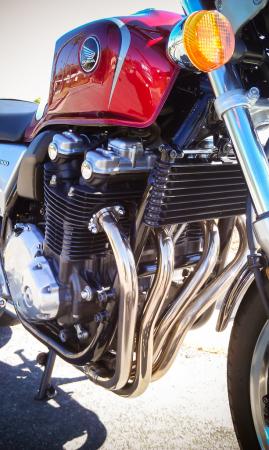 Harley spends thousands of man hours making its V-Twin motors pleasing to look at. Now it’s Honda’s turn with the CB1100’s throw-back inline-Four. Note the stainless steel headers curving to the bike’s right side a la the CB400F from the 1970s. The CB’s designer believed it was important to be able to see the outboard cylinders from the saddle, hence the narrowness of its 3.9-gallon fuel tank painted in a rich Candy Red.
Instrumentation is provided by traditional twin dials for the analog speedo and tach that bookend a small LCD info screen containing two trip meters and a clock but no gear-position indicator. Both hand levers feature adjustable spans. Optional accessories include heated grips, a luggage rack and a chrome headlight bucket.
The CB proves to be easy to ride from the first turn of its wheels. Clutch pull is fairly light, and the low-strung motor pulls smoothly at revs barely into the quad digits. In fact, the CB can pull away from a stop with only clutch modulation – the engine’s low-end response means there’s no need for throttle input if so desired.
With a much less oversquare bore and stroke than contemporary sporting machines (73.5 x 67.2mm), it’s able to tug cleanly from just 2000 rpm and ramps up quite strongly just 1000 revs later. Peak torque of 67.9 ft-lb (factory crankshaft rating) arrives at 5000 rpm, so there’s ample thrust without having to search the tachometer for it. Despite the CB’s modern double-overhead cam and 4-valves-per-cylinder architecture, horsepower crests with a rather modest 85.3 at 7500 revs. Its maximum acceleration feels like about 75 rear-wheel horses.
 The CB1100 is a very rider-friendly machine that’s easy to pilot for almost anyone. Note that its seat is more sculpted and less flat than bikes from the ’70s. The CB1100 is a very rider-friendly machine that’s easy to pilot for almost anyone. Note that its seat is more sculpted and less flat than bikes from the ’70s. |
Would we appreciate more power from an engine this large? Certainly, but consider this: Ray Blank, the recently retired Senior VP of motorcycles for American Honda, put on 4000 miles of the 6000 logged on the Japanese-spec CB1100’s odometer used for internal evaluation. Since Blank is known to be quite a horsepower junkie, that’s speaking volumes.
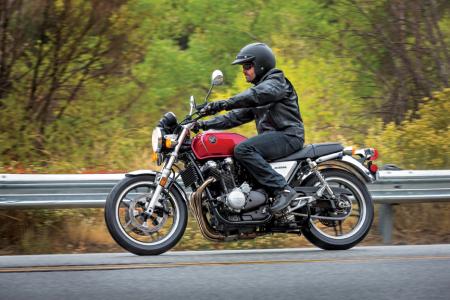 The CB1100’s ergonomics can comfortably accommodate nearly any rider. The CB1100’s ergonomics can comfortably accommodate nearly any rider. |
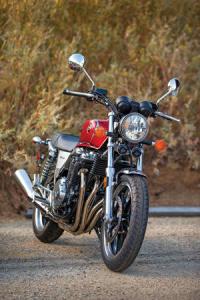 The proportions of the CB1100 look perfect from any angle.
Conclusion
The CB1100 is a surprising breath of fresh air considering its inspiration drawn from Honda’s musty past. Similar in ways to the Triumph Scrambler we recently reviewed, the retro CB stands apart from anything resembling a rival. Its throwback design with the benefits of modern engineering proves the timeless quality of the historic CB series, even in the context of contemporary motorcycles.
The Big Four Japanese manufacturers rarely look back at their past to inspire something modern, but Honda has demonstrated that it could be convincingly achieved. Now all that’s left is to find out if there’s a market in America for riders looking for a nostalgic Japanese ride.
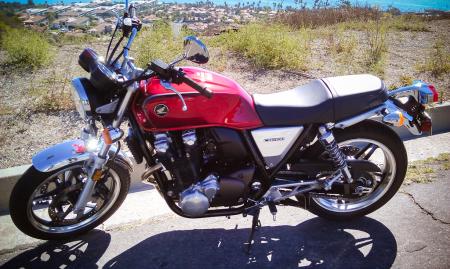 If the CB1100’s styling pulls your heartstrings, you’ll likely be pleased by the dynamic qualities of its riding experience. If the CB1100’s styling pulls your heartstrings, you’ll likely be pleased by the dynamic qualities of its riding experience. |
 Posted in:


0 nhận xét:
Đăng nhận xét