


 02:43
02:43
 Unknown

Due to circumstances beyond MO control, ahem, we did not ride the new Honda CBR600RR at last week's U.S. press launch, but we do have the scoop.

On to the CBR-RR then. It's all-new. As you know, Honda's strategy with the long-running CBR600 has always been "big-circle" philosospy--one bike able to do it all, from daily driver to Daytona racer. With the RR, that philosophy is history. The superzoot racey RR will be sold alongside the pre-existing CBR600F4i--now relegated to sensible-shoes status. On paper, the two bikes don't look dissimilar at all: specs say each weighs 370 pounds dry, 54.7-inch wheelbase for the RR vs. 54.5 for the F4, 24-degree rake for both and nearly identical trail figures (95 for RR, 96 for F4). Both bikes even have 67 x 42.5mm, 599cc engines with 12:1 compression.
 Note the resemblance, Honda wishes to point out repeatedly, between the RC211V...
 ...and CBR600RR
Using this technique in the steering head, main spars and swingarm pivot plates, Honda says, gives its engineers greater latitude in tuning frame rigidity for "enhanced handling."
Compared to the F4I, the RR has greater torsional stiffness in the steering head, decreased lateral stiffness due to thinner rear frame rails and vertical stiffness "uncompromised by a beefy structure for the top shock mount." All of that, taken from the RC211V, is said to result in less wheelspin at corner exits.
 Mr. Swingarm is all trick too, and controlled, like on the RC211V GP Honda, by Honda's new "Unit Pro-Link" linkage system, which sort of compresses the shock from the bottom instead of the top, therefore causing compression of the shock to pull on the lowest frame crossmember instead of pushing on the middle of the frame in typical fashion. It sounds cool and looks cool; mostly it makes room for the RR's 4.8-gallon fuel load to be moved into the much better location the shock used to occupy.
The top half of the fuel tank now resides beneath a plastic cover; ahead of it under the cover sits a new, bigger airbox. And speaking of swingarms, stacking the transmission shafts, etc., allowed the swingarm pivot to move 30mm closer to the crank, which in turn made room for the swingarm to be 43mm longer than the F4i's unit--which produces numerous benefits: better mass centralization again, forward weight bias, and reduced swingarm angle changes as the rear wheel strokes upward.
"Honda says the conventional injectors' proximity to the intake valve gives instant throttle response."
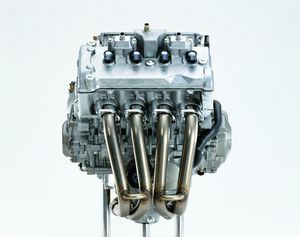 Shorter and narrower, Honda says the new RR engine allows three more degrees of lean to either side.
Peak power comes now at 12,500 instead of 12,000 rpm--with newfound overrev potential (watch the Yam R6 Mamola vids to understand the beneficiality of that round a racetrack) all the way out to 15,000 rpm. RR pistons are therefore 131 grams each instead of 145 g (F4i). Smaller piston-pins are 36 instead of 44 g each. New nutless carburized rods weigh 232 instead of 244 grams apiece. Add it up and you're looking at 4.8 ounces less reciprocating weight, in an engine Honda says is 0.7 kg lighter than the F4i's. Intake valves are now one mm bigger, at 27.5, all the valves are closed by dual springs, and a new, "dual-pivot" camchain tensioner keeps out the dread whip, when applying the whip in top cog.
 That's right, 15,000 rpm (tho max power is at 12,500). F4i peak is 12,000 rpm with 14,2 ceiling.
And this: "A Dual-Stage Air Induction ram-air system feeds dense, cool air to the airbox, but now via larger inner/outer ducts. Extensive testing in the wind tunnel and on the race track showed the larger ducts resulted in a slight increase in steering effort. To counteract that trait, the outer ducts have holes punched through them, an idea Honda successfully tried years before on its Grand Prix roadracers. As a result, the RR makes high-speed transitions with ease and confidence." That's all we have for now. Next step, full-blown comparo?
 Posted in:


0 nhận xét:
Đăng nhận xét